Tracking Collector Productivity Metrics on a Lean AR Team
Small AR teams need leading indicators, not lagging metrics built for larger operations.

Lean AR teams don't fall behind because they skip tracking. They fall behind because they track the same lagging indicators built for a team three times their headcount, and by the time those numbers move, the account that needed attention is already gone.
Why lean AR teams fall behind
On a large team, a 30-day lag in signal is painful but recoverable; on a two-person team, it means accounts tip past the recovery threshold before anyone acts. A signal that arrives 30 days late is an inconvenience for a large AR department with ten collectors and a dedicated analyst. It can absorb the lag, reroute a few accounts, and keep moving. A two-person team doesn't get that cushion. With the same 30-day delay, an account has already slid past the point where a phone call fixes anything.
A limited hours compound the timing delay. A two-person AR team spends most of its week on manual work: calls, generating aging reports, applying cash, chasing disputes. Every hour spent building a dashboard that tracks the wrong thing is an hour not spent collecting. Rigorous tracking of the wrong metric doesn't just fail to help. It actively eats into the capacity it's supposed to be measuring.
Choosing which KPIs to track is a capacity decision made fresh every week, since every metric on the list costs hours a lean team doesn't have lying around. Picking four metrics that each take ten minutes to pull together and log means that tracking effort has already been spent before anyone acts on what the numbers say. A larger team can afford a sprawling dashboard as a hedge against uncertainty. A lean team has to be right the first time, or close to it.
Why DSO misleads lean teams about collector performance
Days Sales Outstanding is usually the first metric any AR team adopts, and it's also the one least equipped to tell a lean team whether its collectors did good work this week. That's not a knock on DSO as a concept. At the executive level, tracking cash conversion speed over time is useful. The trouble starts when a two-person team tries to use DSO as a collector performance signal, which it was never built to be.
DSO changes by industry, by deal size, and by geography, so a generic benchmark can point a lean team at the wrong target entirely. A SaaS company and a manufacturer don't live on the same DSO curve, and chasing a number borrowed from a different kind of business is like training for a marathon using someone else's finish time.
The gap between top performers and the middle of the pack is real money. That's a meaningful stretch of cash sitting uncollected. But DSO can't say why the gap exists. It blends customer payment habits, credit terms, invoice mix, and actual collector effort into one number, so a team staring at a rising DSO has no way to know if a collector is underperforming or if credit just approved a riskier batch of customers.
Average Days Delinquent solves that specific problem. ADD strips out current receivables that aren't due yet and measures only how late the overdue invoices actually are, which separates a credit-terms issue from a collections-execution issue. Vertaccount's 2026 AR dashboard guide treats an ADD under a healthy threshold, with only a modest buffer beyond agreed terms, as a sign of a team doing its job well. When average days delinquent pushes past 30 days, the guide reads that as a collection process gap, not evidence of a slow-paying customer base.
The four metrics that give lean teams the most signal per hour of tracking effort
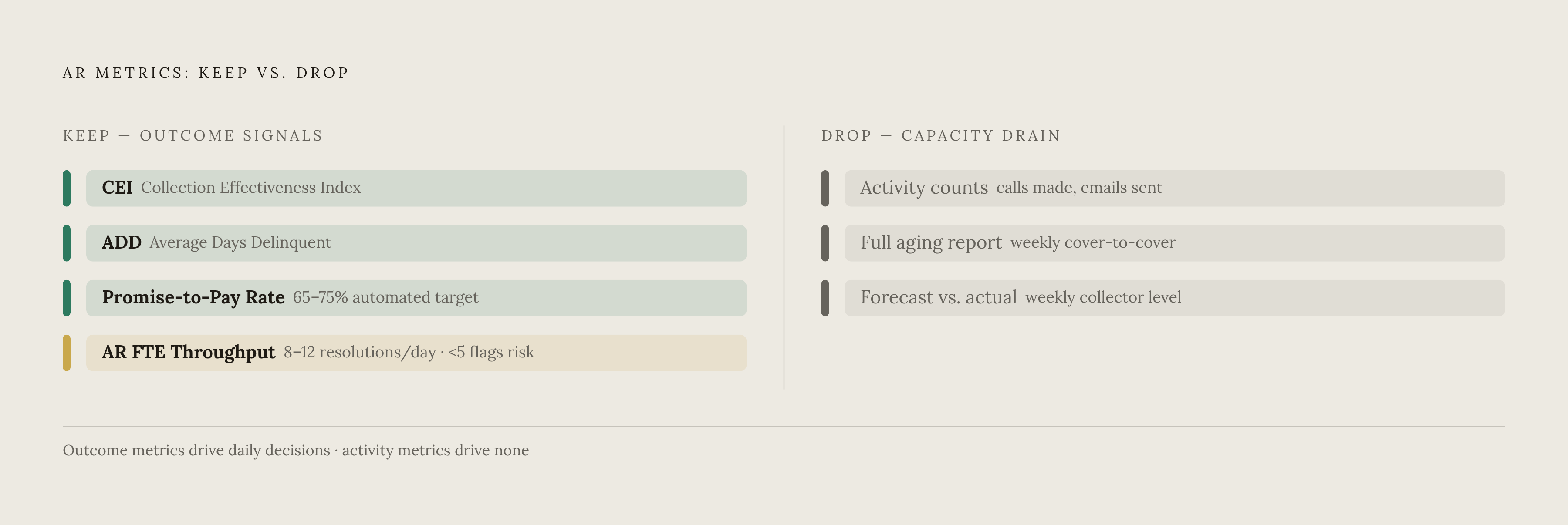
Four outcome-anchored metrics, tracked well, beat eight dashboards tracked loosely. A lean team running CEI, ADD, promise-to-pay conversion, and AR FTE throughput gets more usable signal per hour spent tracking than a larger team juggling a mixed bag of activity and outcome data.
Collection Effectiveness Index measures the share of receivables that were actually collectible during the period and were, in fact, collected. Unlike DSO, it leaves out invoices that aren't due yet, so it isolates whether the team is the bottleneck or the customer base is. The diagnostic value runs high for a lean team specifically: if CEI holds steady while DSO creeps upward, the problem sits in new credit decisions, not in collections execution.
ADD carries forward from the previous section as the surgical complement to DSO, earning its spot here because it moves fast enough to review weekly. A metric that updates slowly is close to useless on a team this size. ADD doesn't have that problem.
Promise-to-Pay Conversion Rate tracks the share of payment commitments a collector secures during outreach that actually turn into cash, rather than just counting how many calls got made. Vertaccount's 2026 dashboard guide benchmarks automated follow-up at a 65 to 75 percent conversion rate, outperforming manual follow-up processes. For a lean team, PTP conversion separates a collector who racks up contacts that go nowhere from one who makes fewer calls that consistently land, and it also catches a common lean-team failure mode: the promise obtained but never followed up on, which disappears from view until the invoice ages further.
AR FTE Throughput rounds out the set, measured either as invoice resolutions per collector per day or dollars collected per collector per period. Vertaccount benchmarks put strong performers at 8 to 12 invoice resolutions per collector per day, with anything under 5 to 6 flagging either underperformance or an overloaded collector. When invoice sizes vary a lot, the dollar-denominated version holds up better, since it doesn't get skewed by one collector happening to work a batch of small invoices.
CEI and ADD can be derived from data already in most ERP systems. PTP conversion needs call outcomes logged, but a lean team ought to be doing that regardless. FTE throughput rides on that same log. None of this requires new software or a new habit bolted onto an already packed week.
Which widely used metrics lean teams should stop tracking
A larger AR department with a dedicated analyst can run a dozen metrics in parallel and let the analyst sort out which ones matter this month.
Activity metrics top the list for removal: calls made per collector, emails sent, accounts touched in a day. These count motion, not results, and they can't tell anyone whether that motion produced cash. A collector blasting out a high volume of emails that never generate a commitment will score better on an activity dashboard than a collector who makes a third as many calls but closes real payment promises. ARDEM's 2026 analysis draws a clean line between activity metrics and decision metrics: activity data is useful background, but it doesn't drive strategic calls on its own. On a lean team, the absence of an analyst between raw data and the decision means that line falls to whoever is collecting, so it has to hold up without someone else translating activity into action.
There's a second cost to heavy activity tracking beyond wasted hours. It can start to function like surveillance, and that friction bleeds into customer relationships a lean team depends on to keep accounts current. ARDEM notes that aggressive collections activity, driven by a push to maximize contact counts, can upset the very customers a team needs to stay on good terms with.
Full aging reports reviewed cover to cover every week belong on the drop list too, because most of what's in that report doesn't change what a collector does that day. The useful version is prioritization by aging bucket, not a full weekly review: put collector time against the 30-to-60-day bucket, focused on the largest invoices in that range, since those accounts are still responsive and the dollars at stake justify individual attention. Chasing invoices deep in the 90-day-plus bucket burns capacity on the least recoverable balances, and a team that organizes collector time by bucket rather than by total accounts touched gets more cash back per hour spent.
Forecasted-versus-actual collections is the third item to cut, at least at the weekly, collector-level grain. It's a genuinely useful number for a CFO doing treasury planning. Reviewing it collector by collector every week adds a task without changing a single daily decision, so it makes more sense folded into a monthly CEI review instead of run as its own weekly ritual.
The one legitimate role activity metrics still play
Dropping activity metrics outright runs into one real objection: CEI takes a full billing period to calculate, so a collector could be underperforming for weeks before that number finally shows it. One activity signal, checked daily, closes that gap without reviving the sprawling dashboard.
Keep follow-up cycle adherence, or right-party contact rate, as the signal that matters, not raw call volume or email counts. It answers a sharper question: is the collector actually reaching the person who can approve payment, not just generating noise. Follow-up cycle adherence asks whether a collector completed the promised sequence of follow-ups within the timeframe they committed to. A drop in that number partway through the month is an early warning that CEI is about to look bad once the period closes. ARDEM's 2026 KPI analysis lists follow-up cycle adherence by collector or team as a process-bottleneck indicator, and treats it as distinct from simple call-volume counts.
The practical two-tier system for lean teams uses a small set of outcome KPIs reviewed weekly: CEI, ADD, and PTP conversion rate. Daily, check one activity signal, either follow-up cycle adherence or right-party contact rate. The daily number serves as a tripwire rather than a scorecard to file away.
The discipline that makes this work is simple: the daily signal should trigger a conversation, never a report. Nobody builds a slide deck about it.
AI-driven prioritization and the new meaning of "productive" for lean collectors
AI-driven worklist prioritization has flipped what counts as good collector performance. A collector who contacts fewer accounts but picks the right ones now posts a better CEI, even if the old activity numbers look flat or lower than before. A lean team still grading itself against pre-AI benchmarks will read that pattern backward and conclude a collector is coasting when they're actually doing the job better than anyone on the old system could.
Quadient's 2026 AR AI ROI analysis describes AI-prioritized collections as steering collectors away from low-risk invoices and toward the balances most likely to actually hurt cash flow if they go unpaid. The gain appears in better targeting, visible in CEI, not in working faster.
That shift means the FTE throughput benchmark from earlier in this piece isn't fixed. As automation absorbs the routine reminder-email volume, collections staff spend more of the day on strategic work: high-risk accounts, negotiating payment terms, resolving disputes. A lean team deciding whether it needs a third collector should first measure its touchless collections rate, the share of invoices that clear automatically without anyone picking up a phone, against total invoices issued. That number shows how much of the volume tier is already handled before anyone asks a human to step in.
The pattern plays out concretely in Esker's published case study on Clario, where automating invoice delivery and dispute handling cut past-due payments by 71 percent and freed collectors to spend their time on higher-value work instead of administrative tasks. Hillcrest Food Service's VP of Finance reported a similar shift, with automated collection tools moving staff time toward customer engagement and away from manual admin work.
None of this is a pitch to buy a platform. It's a recalibration problem. If a lean team keeps grading collectors against benchmarks set before automation arrived, it is measuring the wrong baseline, the same mistake that opened this piece, just wearing a 2026 costume.
Making the tracking system lightweight enough not to consume the capacity it measures
Everything argued so far points to one operating rule: a tracking system only earns its place on a lean team if running it costs less than the decisions it improves. That means four weekly outcome metrics (CEI, ADD, PTP conversion, FTE throughput), one daily tripwire (follow-up cycle adherence or right-party contact rate), and nothing else cluttering the weekly routine.
The CEI and ADD numbers come out of data most ERP systems already hold. PTP conversion and FTE throughput ride on call-outcome logs a team should be keeping regardless of what gets tracked on top of them. The daily signal stays daily precisely because it's cheap: a quick check of follow-up adherence rather than a report, needing only a conversation when something looks off.
The aging report gets consulted by bucket, focused on the 30-to-60-day range where the money is still recoverable and the dollar amounts justify the time, instead of read front to back every week. Forecast-versus-actual moves to a monthly cadence tied to the CEI review, where it belongs, instead of sitting on a weekly checklist it was never suited for.
That's the whole system: four numbers a week, one number a day, and a standing rule that nothing gets added to the list unless it changes what a collector does next. It's the only version of tracking that doesn't quietly eat the hours it was built to protect.