Segmenting Your AR Portfolio for Tiered Collections Treatment
Tailored collection strategies recover more cash while protecting high-value customer relationships.

Segmenting Your AR Portfolio for Tiered Collections Treatment.
Why treating every overdue invoice the same way costs you cash and capacity
A tiered AR collections strategy sorts your portfolio along two axes, balance size and risk profile, and then matches effort to what each account actually needs.
Treating every account the same way causes an arithmetic problem, draining collector hours on low-value accounts while high-value relationships get insufficient attention.
Intuit's 2025 Small Business Late Payments Report found that 56% of small businesses are currently waiting on cash from unpaid invoices, and 47% of those invoices are already more than 30 days overdue Intuit 2025 Small Business Late Payments Report transformance.ai ordwaylabs.com Consumer Financial Protection Bureau. That's not a rounding error. And the businesses hit hardest by these overdue invoices are 1.4 times more likely to run into serious cash flow trouble, which makes the stakes concrete rather than theoretical Intuit 2025 Small Business Late Payments Report.
Now picture the standard, undifferentiated collections workflow: same email templates, same call cadence, same escalation timeline, applied to a long-tail account worth $500 and a strategic account worth $500,000. That's like using the same fishing net to catch a minnow and a marlin. One gets over-handled and annoyed, the other slips through because nobody noticed it was worth chasing harder. Misallocated effort, strained relationships with customers who deserved better handling, and recoverable cash left on the table result.
Despite all this, only 4.13% of midmarket B2B companies have adopted dedicated AR automation tools, which means most teams are still running the same manual, one-size-fits-all workflow they've run for years resolvepay.com. The gap is about shape: accounts that need intensity don't get it, and accounts that need almost nothing get worked anyway, burning collector hours that could go somewhere useful. Most teams can only manually action 30–40% of overdue invoices in a given week, leaving the rest untouched while collectors handle escalations transformance.ai creditpulse.com ordwaylabs.com.
What AR portfolio segmentation means in a collections context
Segmentation, in plain terms, means splitting your debtor portfolio into distinct groups based on shared traits like payment history, balance size, and risk level, so each group gets a response built for it rather than a generic one. Think of it as triage, not a mailing list.
That distinction matters, because segmentation in marketing usually just changes the message. Segmentation in collections changes the action: who calls, how often, through what channel, and at what point someone escalates.
Done well, segmentation gives a finance team three things it didn't have before. Sharper visibility into where the recoverable cash actually sits, instead of a flat aging report that treats every dollar the same. Earlier identification of high-risk accounts, catching them before they age into write-off territory. And a rational basis for handing out collector time, automation, and escalation paths, instead of assigning them by gut feel or whoever's desk the account happens to land on.
Serrala's 2026 AR collections strategy guide points out that automation platforms can now dynamically segment customers using real-time data and route each case to the right collector or workflow automatically. That's the modern version of this practice. It used to be a manual exercise, done in a spreadsheet, updated whenever someone remembered. Now it's closer to a live system.
Segmentation is not a credit score, and it's not a single static rating you assign once and forget. It's an ongoing classification that has to update as behavior changes, because the customer who paid on time for three years and just started slipping isn't the same risk they were last quarter.
The rest of this piece builds out from two dimensions that organize almost every segmentation decision in collections: balance size and risk profile.
The two axes that structure every segmentation decision: balance size and risk profile
According to Trade Credit & Liquidity Management (David Schmidt, August 2025), collection automation strategies get built along two dimensions, balance size (large or small) and risk profile (high or low), which together produce four quadrants. Each quadrant calls for a genuinely different playbook, not a volume adjustment on the same one.
Large balance, high risk is the quadrant that keeps CFOs up at night, and rightly so. It calls for an aggressive approach: frequent, fast escalation through direct phone calls, because any delay here creates real loss exposure. Large balance, low risk gets a comprehensive approach instead, formal notices first, calls only if there's no response, escalating moderately in a way that keeps the relationship intact. These are good customers who occasionally pay late, not risks in the making.
Small balance, high risk sounds low-stakes but isn't, not in aggregate. The right move is aggressive and notice-heavy: multiple written notices plus follow-up calls, since automation is cheap here but some direct intervention still stops cumulative losses from piling up across hundreds of small accounts. Small balance, low risk is the quadrant to leave alone. A laissez-faire approach, infrequent touches, automated notices, slow escalation, works fine, because chasing these accounts hard just costs more than it recovers.
Risk profile itself isn't a vibe, it's measurable. Invoice aging tells a similar story from a different angle. Accounts sliding into the 61 to 90 day window hit an inflection point where recovery odds start declining meaningfully, and the 90+ day bucket represents the highest write-off risk, a risk that rises significantly once that 90+ bucket makes up more than 20% of total AR resolvepay.com resolutai.com.
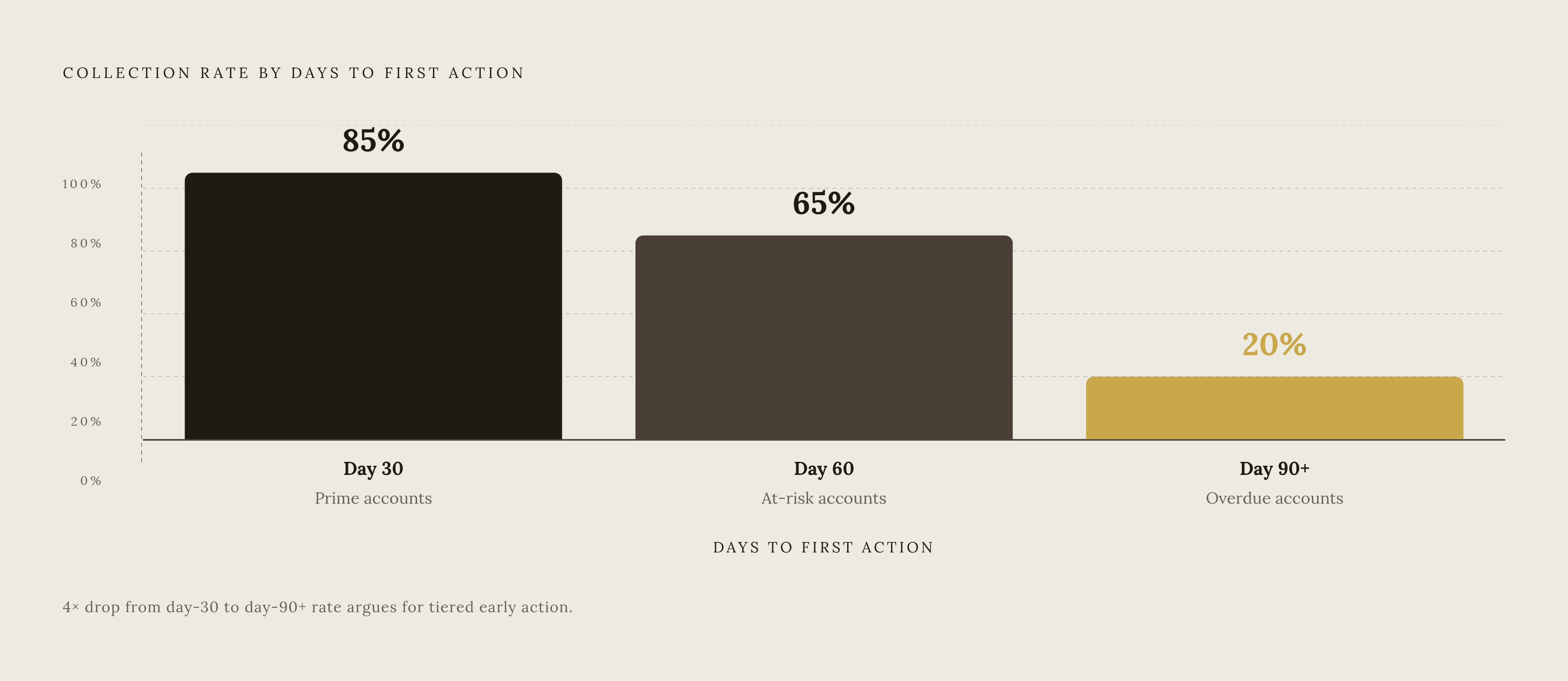
Timing backs all of this up with hard numbers. Prime customers reached within 30 days get collected at an 85% rate transformance.ai tradecredit.substack.com resolvepay.com resolutai.com ordwaylabs.com. Wait until day 60 for at-risk accounts and that number drops to 65% transformance.ai tradecredit.substack.com resolvepay.com resolutai.com ordwaylabs.com. Wait until 90+ days and the collection rate drops to just 20% transformance.ai tradecredit.substack.com resolvepay.com resolutai.com ordwaylabs.com. That's the whole argument for acting on risk early, condensed into three data points: speed isn't a nice-to-have, it's most of the ballgame.
The quadrant model is the map. What comes next is laying a second lens over that map, revenue concentration, to produce the full three-tier framework. Credit score thresholds show that accounts scoring 750+ pay at or below terms, those scoring 650–699 pay 15–25% past terms, and accounts below 650 pay 40–60% above terms tradecredit.substack.com creditpulse.com ordwaylabs.com Equipment Finance News.
Layering revenue concentration onto the quadrant model to build three workable tiers
The quadrant model alone can't handle this wrinkle. That's a steep curve, and it means balance size and risk alone don't tell you everything. A small-balance, high-risk invoice from your biggest revenue relationship needs different handling than the identical invoice from a customer who barely moves the needle.
So the framework adds a third layer, revenue concentration, producing three tiers.
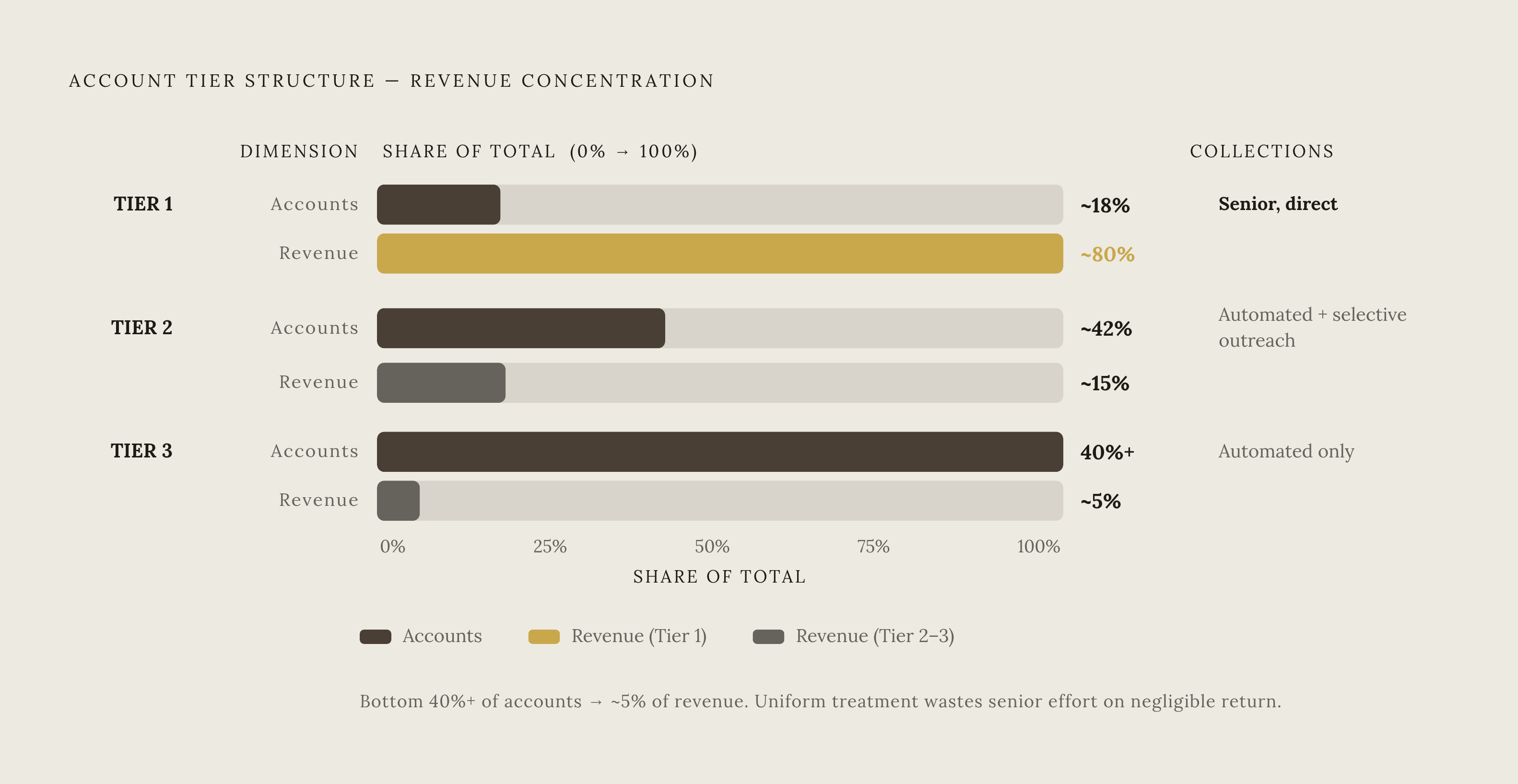
Tier 1: Strategic and high-value accounts, the top 15 to 20% of the portfolio by revenue. These are the relationships where losing the account costs a lot more than the unpaid invoice itself. Within Tier 1, split accounts by risk profile (high vs. low) using the quadrant logic, but treat even the low-risk ones with attentive monitoring.
Tier 2: Mid-value, moderate accounts. This is the blend zone: automation and personal follow-up working together, with risk profile deciding which way the treatment leans. Higher-risk mid-tier accounts get more frequent human outreach. Lower-risk ones ride on structured automated sequences until something changes.
Tier 3: Tail, low-value accounts, the bottom 40%-plus that often adds up to only about 5% of total revenue. The one exception: high-risk tail accounts still need notice-heavy automated sequences, because enough of these left unattended can add up to a real write-off problem even if no single account matters much on its own.
This three-tier structure solves the long-tail concentration, where a small share of accounts drives most revenue. A big chunk of customers generate very little revenue individually, but treated identically to everyone else, they eat collector hours that would be far better spent on Tier 1 relationships and complicated Tier 2 disputes. Trade Credit & Liquidity Management (Schmidt, August 2025) reports that Pareto concentration in practice means roughly 15–20% of accounts generate the vast majority of revenue, while the bottom 40% or more of customers often account for only about 5% of revenue tradecredit.substack.com resolvepay.com creditpulse.com resolutai.com.
What each tier's collection treatment looks like in practice: channel, cadence, and escalation path
Tier 1 accounts don't go into a generic dunning sequence. A senior collector or account manager owns the relationship directly, because this is the account where showing up with a form letter would be a genuinely bad look. Alignment with sales matters too: aggressive follow-up can torch a large deal in progress, so sales teams need a way to flag when collections cadence should ease off around an active negotiation. Flexible tools, like installment plans on large invoices, are legitimate here, not a concession. They signal partnership instead of pressure, and they tend to improve recovery without straining the account. The goal at this tier is resolution, full stop: collecting a payment, untangling a dispute, resolving a missing document, or freeing a stuck vendor portal submission.
Tier 2 runs on a structured, automatic sequence triggered by invoice age, balance, and risk tier. A workable cadence includes a reminder before the due date, another on the due date, then escalating follow-ups at 3, 7, 15, and 30 days past due, a rhythm consistent enough that customers start prioritizing these invoices simply because they know the pattern transformance.ai tradecredit.substack.com ordwaylabs.com. Higher-risk mid-tier accounts get a phone call or a scheduled check-in layered on top, rather than relying on email alone. And a lot of what stalls mid-tier accounts isn't unwillingness to pay, it's friction: missing W-9s, unresolved submissions stuck in a vendor portal like Coupa or Ariba, billing errors nobody's fixed yet. Chasing those blockers down proactively often clears the invoice faster than another reminder email ever will.
Tier 3 leans almost entirely on automated notices, saving personal intervention for accounts whose risk profile changes. The clear trigger for stepping in manually is finishing the full automated cycle first, not jumping in halfway through because someone's nervous. And the tier isn't the only variable that matters: a customer ten days late usually just needs a nudge and some clarity, while a customer ninety days late may need a payment plan or a dispute resolved, so tier and aging bucket work together to shape the actual response.
When to move an account to a third party
Handing an account to a collection agency shouldn't happen on autopilot. Ordwaylabs states that internal AR processes, including the full automated dunning cycle and direct collections effort, should run their course before any third-party engagement starts. Skipping straight to outsourcing is a bit like calling a tow truck because your car won't start before checking if it's just out of gas.
Caine & Weiner, in an August 2026 piece, reframes the decision usefully: the right framing for CFOs isn't who makes the call, it's which approach gives the best opportunity to recover cash while using internal resources efficiently. That's a cleaner way to think about it than "should we outsource," which tends to turn into an emotional debate rather than a financial one.
Their three-group heuristic sorts accounts by what is actually causing the non-payment. Group 1 covers administrative delays, a missing purchase order, and a billing correction in progress, and these stay internal because the fix is procedural. Group 2 covers active relationships that acknowledge the balance and are still engaging, and these also stay internal, since the relationship carries strategic weight worth protecting. Persistent delinquency, missed commitments, and stalled communication appear in Group 3, and that's where outsourced recovery earns its keep.
The economics matter too. Third-party agencies typically charge 25 to 50% of whatever they recover, and resolutions can take anywhere from 30 to 90 days transformance.ai tradecredit.substack.com ordwaylabs.com. Both figures need to sit inside the tier-level math before a handoff decision gets made, since automation handles the full Tier 3 load, freeing human capacity for Tier 1 relationship management and complex Tier 2 disputes transformance.ai tradecredit.substack.com ordwaylabs.com.
Reputational risk doesn't transfer with the account. Customers don't distinguish between a company and the agency calling on its behalf, complaints attach to the original brand regardless of who dialed the phone, and in a tight-knit industry that reputational cost can outweigh whatever gets recovered on a single invoice. There's also a quieter cost to fragmenting the process: splitting first-party and third-party collections across separate vendors tends to break the continuity of payment history, prior communications, and engagement notes that should follow an account through its lifecycle. A unified escalation path keeps that context intact. For teams with a specific, narrow bottleneck, modular outsourcing, handing off just aged-debt recovery while keeping credit policy in-house, offers a reasonable middle ground.
How AI and dynamic segmentation change what's operationally possible
Segmentation used to be a periodic chore: someone reviewed the portfolio, bucketed accounts, and left the bucketing alone until a problem forced a second look. That model is aging out.
Serrala's 2026 guide describes automation platforms that segment customers dynamically off real-time data and route cases automatically to the right collector or workflow, with AI-driven segmentation continuously learning from payment patterns to sharpen the groupings over time. Predictive AR tools push further still, using machine learning to forecast which invoices are likely to slip, which customers might default, and how outside factors like seasonality or broader economic conditions are shaping the picture. That's a real shift, from reacting to a late invoice after it happens, to seeing it coming and adjusting the account's treatment beforehand.
This isn't a fringe bet, either. PwC's 2025 Global Treasury Survey found that 74% of treasury leaders are already expanding or actively using AI, with a specific focus on machine learning and predictive analytics. That's most of the field, not the early adopters out on a limb.
Operationally, dynamic segmentation changes a few concrete things. Accounts migrate between tiers on their own as behavior shifts, so a Tier 2 customer who misses two payments in a row slides into a higher-risk queue without anyone manually re-sorting the spreadsheet. And automation absorbs the entire Tier 3 workload, which frees up human attention for Tier 1 relationships and the messier disputes living in Tier 2.
None of this replaces judgment. Automation handles execution and routing well, but the operational blockers, portal friction, a missing document, a communication gap between two departments, still need a human chasing them down. Systems don't resolve those on their own; they just make it obvious where the block is.
Building the segmented system: practical steps to move from concept to working framework
Getting from "this sounds reasonable" to a working system takes a sequence, not a single meeting.
Start with an audit. Pull a current aging report and map every account against both revenue contribution and risk indicators, credit score band, days-past-due history, and aging bucket, so the map is built on data rather than memory. From there, set tier boundaries that actually fit the business: the 15 to 20% / mid / bottom-40%-plus split is a reasonable starting shape, not a rule carved in stone, and it should get calibrated against the real revenue distribution sitting in the portfolio tradecredit.substack.com resolvepay.com creditpulse.com resolutai.com.
Once the tiers exist, assign a collection treatment to each quadrant inside each tier, channel, cadence, escalation trigger, and handoff criteria, all documented before a single workflow gets configured. Skipping this step and building the automation first is how teams end up automating a bad process faster. Alongside that, the primary objective needs stating out loud: is the goal maximizing cash flow, minimizing bad debt, or balancing both, since that determines how aggressively each tier is worked.
Before anything launches, loop in sales. Share tier assignments and escalation triggers with account-facing teams so an aggressive collections call doesn't land in the middle of a live negotiation and blow it up. After launch, keep watching the aging bucket composition, since a 90+ day bucket that climbs past 20% of total AR is a signal that write-off risk is rising across the whole portfolio, not just a nudge to escalate one account resolvepay.com resolutai.com.
And last, treat the whole thing as alive, not finished. Segmentation isn't a project with an end date, accounts move, behavior shifts, and a good system reveals those migrations on its own wherever the tooling allows it.
The payoff for building it this way is straightforward. Finance teams that stop chasing every account the same way recover more cash, keep their important customer relationships intact, and put collector time where human judgment actually changes the outcome, instead of spreading it thin across a portfolio that was never uniform to begin with.