Escalating Tone Across a Multi-Touch Collections Sequence
A five-stage sequence matches tone to days past due to collect without burning relationships.

Late payment is the normal condition of B2B commerce, not a glitch in it. Atradius's 2026 US Payment Practices Trends report finds that 55% of US suppliers say their customers delay invoice payments. More than half the industry is running some version of a chase sequence right now, today, whether or not anyone wants to call it that. The money involved adds up fast: Kaplan Group's 2025 research puts the average annual cost of late payment at tens of thousands of dollars per US company, and a real slice of businesses lose six figures a year to it. QuickBooks's 2025 small-business data shows that companies sitting on a high volume of overdue invoices are far more likely to report cash flow problems than companies with few of them; roughly half of the high-overdue group struggles with cash flow. Put those three facts side by side: a single soft reminder email is no match for the scale of the problem. The volume of unpaid invoices and the size of the money at stake call for a tiered, repeatable system rather than a hopeful nudge sent into the void.
Repeating the same message louder does not collect the debt
Sending the same polite nudge three times in a row does not apply pressure. It teaches the customer something, and what it teaches is that your payment terms are more of a gentle suggestion than an actual deadline. Emagia's AR glossary points out that inconsistent follow-up tells a customer that enforcement is unlikely. Every repeated, unchanged reminder quietly reinforces the exact delay it was supposed to fix. Meanwhile the invoice is aging, and the longer it sits unpaid, the less likely it ever gets collected, so every week spent sending the same email is a week of lost ground, not a neutral holding pattern. There are two ditches on either side of this road. One is staying too soft for too long, which reads as weakness and gets the invoice shuffled to the bottom of someone else's pile. The other is going in hot and threatening on day two, which burns a relationship over what might just be a lost invoice or an AP department that's short-staffed. AccountRecovery.net's July 2026 webinar, featuring practitioners Dave Snow, David Mitchell, Justin Franklin, and Alec Tilley and moderated by Mike Gibb, frames the real goal as holding both things at once: keep the customer's dignity intact while still holding them accountable. Snow put it directly in that session: "the relationship is the money." Escalating tone, deliberately and in calibrated steps, is the only route between those two ditches.
The five-stage arc: how a well-designed sequence reads as a narrative, not a nagging loop
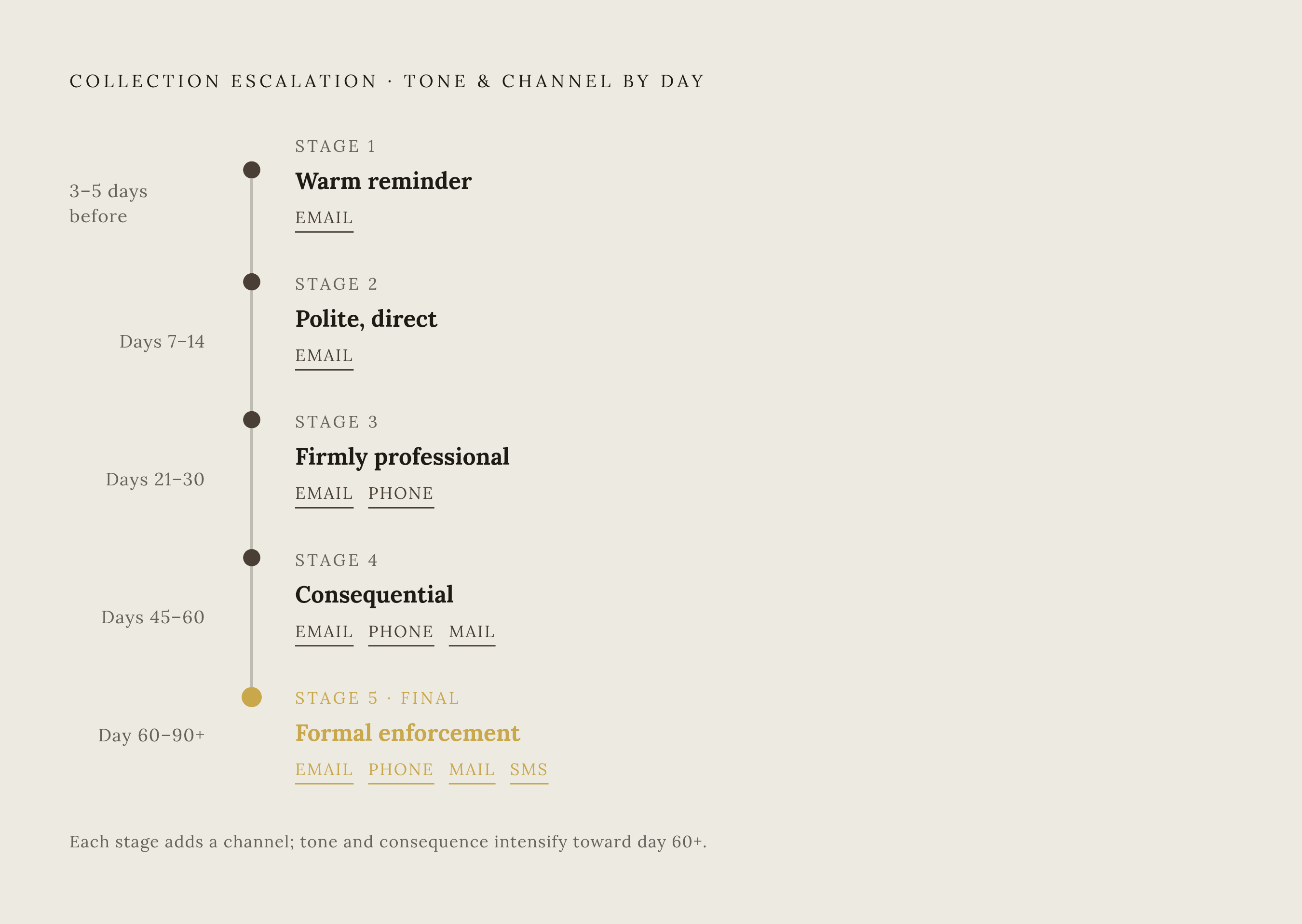
A collections sequence that works reads like a story with rising stakes, not five copies of the same complaint. CreditPulse's collections template guide sets the underlying rule: tone and urgency should track how many days past due the invoice is, from the very first pre-due nudge all the way to the final notice. The first stage lands three to five days before the due date and functions as plain customer service rather than collections, a warm, proactive touch meant to create goodwill and catch problems early (Resolutai runs a four-stage version of this model rather than five). The second stage, covering roughly days seven through fourteen past due, stays polite but gets direct, assuming the best of the customer (a spam filter, a backed-up AP desk) while quietly getting the invoice back onto someone's radar, a framing that lines up with Beancount's 2026 five-step model, where Step 1 actually spans days one through fourteen past due rather than splitting off a separate week-two stage. The third stage, days twenty-one through thirty past due, turns firmly professional: the invoice is now officially overdue, someone is tracking it, and the temperature rises without tipping into hostility. The fourth stage, days forty-five through sixty past due, gets consequential, naming the actual contract terms in play, late fees, a possible pause in service, a move toward a formal collections process, and shifting the entire tone from helpful to formal (this maps to what Beancount labels Step 3 in its own five-step sequence, not a fourth stage by that name). The fifth and final stage, somewhere past day sixty and running to ninety or beyond, is formal and leaves no room for misreading. Resolut AI is specific on this point: by this stage the wording has to be unambiguous. What holds the whole arc together is that each stage answers directly to what happened (or didn't) since the last one, so the customer experiences a logical progression instead of random pressure appearing between stages.
What each touch says (and what it deliberately leaves unsaid)
Word choice in a collections sequence isn't a style preference, it's the mechanism that makes the sequence work or fail. Beancount's 2026 framework lays out the clearest possible before-and-after: "please remit at your earliest convenience" gets ignored, while "please remit $4,892.50 by May 15" gets paid. The second version removes every excuse to put it off. Resolutai's guidance warns against accusatory framing like "you have been ignoring our notices" and recommends neutral, factual language instead, something like "we have not yet received payment for invoice #1256, due [date]." That phrasing keeps the door open and lets the customer save face while still fixing the problem. By the middle stages, days twenty-one through forty-five, the tone firms up without turning threatening: the invoice's age is stated directly, and any consequences mentioned come straight from the contract rather than being invented on the spot. Vagueness at this point costs credibility, the tone needs to signal that a real person is watching this account, not a template on autopilot. In the late stages, from day forty-five out past ninety, discipline keeps the message credible, preventing escalation language from sounding like a bluff. Resolutai specifically warns against slapping "final notice" on a message that isn't actually final, since false urgency trains customers to tune out every escalation signal that follows. Once a message says final, the sender has to be ready to follow through on it. At this stage, brevity does more work than length: a short, specific message signals resolve, while a long one signals doubt.
Escalating the sender, not just the subject line
Changing who sends the message is one of the sharpest tools in the whole sequence, and it's also one of the most underused. CreditPulse notes that a reminder from an AR specialist simply doesn't carry the same weight as the identical message sent from a CFO or a senior account executive, and recommends making that switch around the thirty-day mark. The mechanism is organizational signal: once a senior name shows up in the inbox, the customer isn't dealing with an automated queue anymore, they're dealing with a person whose attention is expensive, and that costliness itself says the matter is serious. It also gives the customer a graceful way to bump the invoice to the front of the line without it reading as an admission that they were negligent, which keeps the relationship intact even as the pressure rises. None of this requires the CFO to sit down and draft the email. It requires the message to go out under that name, written with real, specific knowledge of the account, invoice number, history, prior contact, so it reads like genuine attention rather than a mail-merge with a fancier signature. That means the AR team has to hand the escalating sender clean, accurate context before the message goes out, or the whole mechanic falls flat the moment the customer replies with a question nobody briefed the CFO to answer.
Channel escalation runs in parallel with tone escalation
The channel a message arrives through is part of the message itself. A printed letter in the mail reads as more serious than the fifth email in a thread, even when the words inside are identical, because the format alone tells the customer something about how much this matters. Physical mail earns its place specifically at the late stages: PostGrid's analysis finds that introducing a printed letter after emails have been ignored lifts response rates by 20 to 35%, since a letter cuts through inbox clutter, signals formality, and creates a documented, dated record of contact that matters if the account ever needs legal follow-up. The channel ladder tracks the tone ladder step for step. Early on, email alone is enough, since it's low-friction, easy to document, and doesn't feel like an intrusion. In the middle stages, a phone call gets added alongside email, so the customer is now facing two channels instead of one, which is harder to simply let sit in an inbox. By the late stages, physical mail comes in, and SMS where it fits, both carrying a weight and urgency that email by itself can't match. None of this is a general sales-cadence trick borrowed from another department. It's the same escalation logic from the tone ladder, applied to the format the message travels in.
One escalation ladder does not fit every account
The five-stage arc is a default, not a script carved in stone, and account history should change how fast a given customer moves through it. accounting.events' overdue invoice template guide draws the line clearly: a long-standing client who reliably pays by day thirty-five needs a far gentler touch than a brand-new customer who's gone completely silent at day twenty-one, even though both invoices might be exactly as overdue on paper. That means the sequence for a new, unresponsive account should look noticeably different from the one used for a longtime client having a single off month. AccountRecovery.net's July 2026 practitioner transcript names the real principle: holding a customer's dignity and holding them accountable at the same time is a judgment call, made fresh for each account, based on the actual relationship on file. Good AR teams read that context before they pick a starting point on the arc. Automated systems that fire the same five emails at every account regardless of history burn goodwill on customers who never needed the pressure.
What breaks a well-designed sequence: the enforcement credibility problem
The strongest case against careful, calibrated escalation is a straightforward incentive argument. The Collection Department's practitioner blog notes that some collection models reward speed over relationship, which pushes teams toward aggressive tactics early rather than late, and InvestigateTV's November 2025 investigation found real evidence that some debtors do respond faster to aggressive contact. The team faces real pressure to use it, and that pressure is not going away on its own. But the costs of leaning into it are rising too. FTC data cited in that research shows collection complaints climbing sharply since 2024. The aggressive shortcut comes with growing regulatory and reputational exposure attached. The deeper failure mode is about follow-through rather than which tactic gets picked. A five-stage sequence only works if the team behind it is actually prepared to act at the point the language promises action, late fees applied when the message says they will be, service paused when the message says it will be, escalation handed off when the message says it's coming. A sequence that threatens consequences it never delivers teaches the customer the same lesson as sending the same soft reminder three times: that the sequence carries no actual enforcement behind it. The architecture can be perfectly designed and still collapse at the last step, the one where someone has to actually pick up the phone, send the file to collections, or pause the account, because the whole arc's credibility rests on that final action matching every word that came before it.