Writing Collections Messages That Preserve the Customer Relationship
Specific message structures and sequencing preserve revenue more than aggressive tone ever will.
A collections message asks for money on the surface. A collections message tells the customer exactly how the sender sees them: as a partner who slipped, or as a problem to be managed. Customers read both messages at once, even when only one of them is written down.
That creates a real tension for finance teams, and it's structural, not a matter of tone training. The same email has to pull cash in now while protecting a relationship that, in B2B billing especially, is worth far more than the invoice sitting in front of it. Recurring clients generate recurring revenue. Lose the relationship chasing one payment, and the math stops working in the sender's favor.
Customers who feel mishandled during collections sometimes withhold payment even when they have the money sitting in the account. Aggressive tactics don't just fail to collect in those cases. They actively block collection, turning a slow payer into a non-payer out of something closer to spite than inability. Recovering one overdue invoice while torching the customer's willingness to ever do business again is a loss with a receipt attached.
Resolut's 2026 analysis of B2B collections makes the point directly: aggressive call scripts, rigid repayment plans, and one-size-fits-all strategies don't just underperform, they backfire. They raise costs, shrink recovery, wear down the trust that made the customer easy to collect from in the first place, and the data makes the lesson plain: collections isn't a side task bolted onto accounting, but a running test of the relationship, administered every time a reminder goes out.
How structural choices in a message, not just word choice, signal threat or partnership
Tone gets most of the attention in collections advice, but structure does more of the actual signaling. Whether a message names a specific invoice, whether it assumes the customer forgot or the customer is dodging, whether it opens a door for conversation or just states a demand: these choices shape how the message lands before the reader even processes the adjectives.
Assuming oversight rather than intent is one of the cleanest signals a sender can send. It treats the customer as a busy professional who missed something, not a delinquent who's hiding. That one assumption, built into the structure of the message, does more relationship work than any amount of polite phrasing layered on top of an accusatory frame.
Specificity works the same way. A message that names the invoice number, the amount, and the due date tells the customer the sender is organized and paying attention, and that quietly raises the cost of ignoring it. Compare that to a generic message with no invoice reference, no named contact, and no clear next step. That kind of message tells the customer the account isn't being watched closely, which invites them to push it to the bottom of the pile.
Resolut's 2026 analysis treats this as a systems problem. When collections runs as a set of disconnected tasks instead of a controlled workflow, the messages that come out of it reflect the disorganization behind them, and customers notice the pattern across months of contact, not just in a single email.
The clearest test for any collections message: does it make the next step easier for the customer, or harder? Friction in the call to action (a buried link, no clear contact, a multi-step portal process) is itself a signal of indifference, regardless of how friendly the opening line sounds.
The Timing of the First Message
The first message in an effective sequence is a reminder sent before the due date, and that single timing choice reframes the entire exchange from adversarial to helpful.
Pre-due-date outreach works because plenty of late payments start as oversight, not refusal. A low-stakes nudge sent a few days early resolves the problem before it ever becomes one requiring escalation, a phone call, or a tense email thread. CGI's collections strategy framework argues collections shouldn't start with a missed payment at all. Building systems that catch early warning signs, like rising credit usage or a declining credit score, lets organizations trigger proactive outreach before the customer falls behind in the first place.
The early message does something else too: it sets the tone for everything that follows. A customer who gets a friendly, organized nudge before the due date learns that the sender is attentive and easy to work with. That baseline makes later escalation, if it's ever needed, feel like a natural next step.
Waiting until day 30 or 60 to make first contact gives up the window when the customer was most likely to pay without friction. It also forces the sender into a reactive position, where every tonal choice gets harder because there's no goodwill banked from earlier contact. A reminder sent before the due date is about helping someone stay on track. A message sent 45 days late is about recovering ground that's already been lost. Those are two different jobs, and they require two different scripts.
The Graduated Escalation Sequence
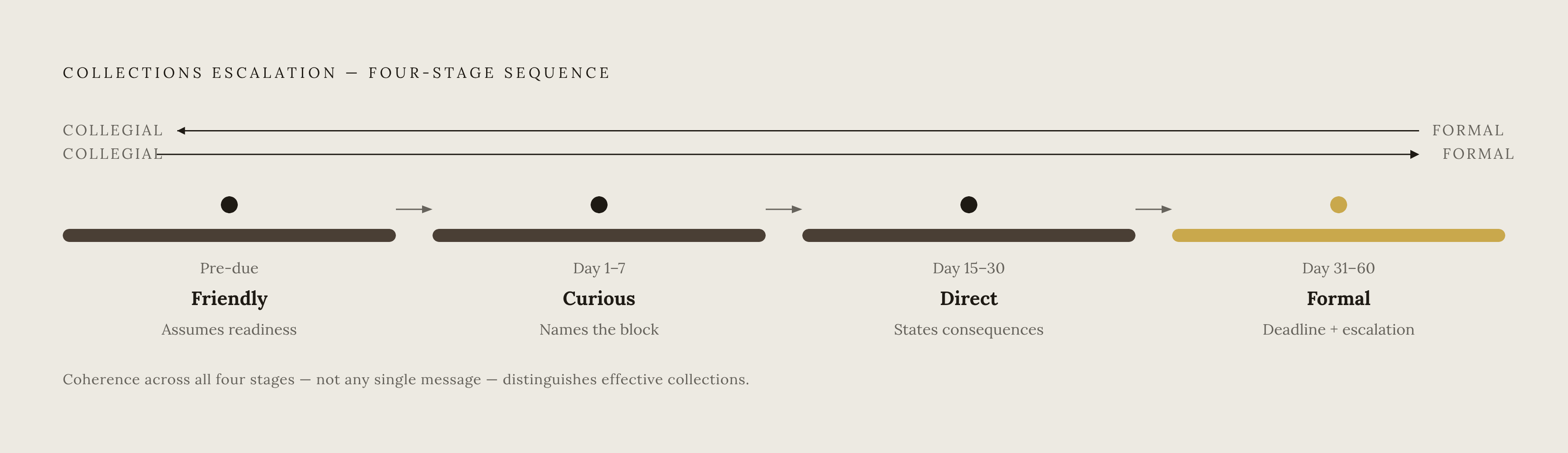
Collections communication works best as a sequence, not a single message, and the structure of that sequence carries much of the relational weight. Each stage should prepare the customer for the next one, so nothing feels sudden or punitive.
Stage one lands before the due date. It's friendly and brief, assumes the customer already has what they need, and names the invoice, amount, and due date along with the payment link. The tone here is the one a good account manager uses with a client worth keeping, not the tone of a collections department.
Stage two covers day one through day seven past due. The message still assumes oversight rather than intent, since busy operations teams miss things. It names the specific invoice once more and asks whether anything is blocking payment, such as a dispute, a missing document, or a portal issue. This stage opens a door.
Stage three covers day 15 through day 30 past due. The tone shifts from collegial to direct, while staying professional. The message names the invoice, states the number of days past due, and references the earlier outreach so the customer knows this isn't a first contact. It makes the consequences of continued delay clear by describing what happens next, without threatening anything.
Stage four covers day 31 through day 60 past due. The tone turns formal, and the message references the full history of contact attempts. It escalates to a named senior contact on the sender's side, which signals seriousness without handing the account to a collections agency or legal team yet. It also offers a specific path to resolution, like a payment plan or a call, alongside a clear deadline.
The sequence as a whole matters as much as any single message in it. A customer who receives a coherent escalation feels like they're dealing with an organized, serious creditor. A customer who receives a string of inconsistently toned messages feels like they're being managed erratically, and that erodes both trust and the motivation to pay.
The specific language choices that separate partnership messages from threat messages
The gap between a message that collects and a message that damages the relationship often comes down to one framing choice: does it treat the customer as a partner working through a problem, or as a subject being managed?
A few patterns consistently backfire. Passive-aggressive phrasing like "As you may recall…" or "Despite our previous attempts…" signals irritation and invites defensiveness. Implicit threats dressed up as reminders, like "To avoid further action…" sent when no prior warning exists, read as bluffing and damage credibility. Generic salutations and unnamed invoices tell the customer nobody actually looked at their account before hitting send. Moralistic language, appealing to fairness or shared obligation, tends to land as scolding rather than communication, which rarely moves anyone to open their wallet faster.
On the other side, a few habits consistently work. Naming the person and the specific invoice in the first sentence signals attentiveness and quietly raises the stakes of ignoring the message. Opening with a presumption of good faith (something like "We wanted to make sure this didn't slip through" instead of "We note you have not paid") changes the entire emotional register of the email. Asking a specific question, like "Is there anything on our end we can clarify?" invites a response and often reveals the real blocker behind the delay. Making the payment action the easiest possible next step, with a direct link and a named contact rather than a multi-step process, removes the last excuse for delay.
A hospital debt study found that messages including the recipient's name significantly improved payment rates compared with generic reminders, while appeals to social norms or shared obligation produced no meaningful impact. Personalization at the name level changes behavior. Moral appeals mostly just take up space in the email.
Resolut's B2B collections best practices flag the opposite risk too: if every aging invoice gets a lawyerly tone regardless of age or relationship, strategic accounts remember that treatment long after the invoice is paid. Using legal escalation too late sends its own signal, telling customers that the sender's terms aren't actually enforced. Gentleness without a credible escalation path behind it teaches customers that non-payment carries no real cost.
How operational blockers change the message entirely
A large share of overdue B2B invoices are a process problem, not a willingness problem: a missing W-9, an unapproved purchase order, an invoice stuck somewhere in a supplier portal nobody's checking. Sending a pressure-tone message to a customer stuck behind a process block adds friction without producing a single dollar of payment, because the customer isn't choosing not to pay. They can't pay yet, and no amount of urgency changes that.
The message for a blocked invoice has one job: surface the specific blocker and offer to clear it, rather than escalate urgency that has nothing to push against. A few blockers recur often enough that finance teams should expect them and write around them directly. The invoice might not be loaded into the customer's procurement or accounts payable platform yet, in systems like Coupa or Ariba. The customer's AP team literally cannot process a document they've never seen. Vendor documentation like W-9s, certificates of insurance, or banking details might be missing or outdated, and the customer's AP system may be built to block payment release until that paperwork clears. A disputed line item or delivery discrepancy might be sitting in informal limbo because the customer never formally raised it as a dispute, so it just sits there unpaid and unresolved. Or the message might simply be going to the wrong person, landing in the inbox of someone who no longer manages AP while the actual decision-maker never sees it at all.
Resolut's 2026 framework names this precisely: discounts don't fix an invoice that's missing a purchase order or sitting in the wrong approver's inbox. The blocker has to be cleared first, before any payment incentive or escalation tactic has anything to work with. A message written for a blocked invoice should name the suspected blocker, offer a specific way to resolve it, and confirm who the right contact actually is. That turns a chase email into a joint problem-solving message, which tends to get faster results than pressure ever does.
When to Raise Urgency
The strongest case against relationship-first collections is that softness lets chronic non-payers off the hook, and that objection has real teeth when escalation gets treated as a last resort instead of a planned stage in the sequence.
The fix is sequencing empathy and firmness correctly: early messages protect the relationship, later messages enforce the terms, and a customer who's been through a coherent, respectful sequence has no real grievance once escalation finally arrives. Raising urgency too early, like threatening legal action or service suspension on a day-15 message, reads as desperation. Customers who feel threatened by early escalation are more likely to disengage, dispute the invoice, or delay payment, even when they're fully capable of paying on time.
Waiting too long carries its own cost. A customer who receives five friendly nudges with zero consequences learns, correctly, that the terms aren't enforced. Once that lesson sets in, the relationship dynamic shifts in the customer's favor in ways that are hard to walk back later.
Resolut's B2B collections guidance frames legal escalation as a control point in the sequence, not a tactic to reach for first. Used too early, it damages the relationship. Used too late, it leaves money on the table and tells the customer that the sender's terms were never really enforced to begin with. The practical trigger for raising tone is whether the customer received a specific, blocker-clearing path and simply didn't respond to it. Time alone is a weak signal. A specific offer that went unanswered is a strong one.
High-value, strategic accounts deserve a different timeline than transactional, one-off accounts. A named account manager reaching out personally reads very differently from a form letter, and customers can tell the difference immediately.
Segmenting Accounts by Relationship Type
Sending the same message to every overdue account treats a long-term strategic client the same as a one-time transactional buyer, and that uniformity is itself a signal about how much the sender actually values the relationship on the other end.
High-value recurring clients need messages that reference the specific relationship directly, ideally sent from or signed by a named account manager. These messages should offer resolution options, like payment plans or a scheduled call, well before any pressure gets applied, because the cost of damaging a recurring relationship is almost always higher than the cost of a short delay in payment.
Reliable but slow payers need a different script entirely. These are accounts that pay in full, just not on time. The message to them can stay direct and low-stakes, focused on logistics and timing rather than urgency, because urgency aimed at someone who was always going to pay just reads as noise. Matching the message to the account type is the practice itself, built into who gets which email and why.