When to Stop Emailing and Switch Collections Channels
Switch to phone calls and direct outreach when email stops getting responses.
Email handles the first stage of collections because it does three things well: it creates a written record of every exchange, it carries the invoice itself as an attachment, and it scales across hundreds of accounts at almost no extra cost. No phone tree, no hold music, no scheduling headache. A finance team with a large batch of overdue invoices can run all of them through the same sequence at the same time, and the system doesn't get tired or short with anyone on the last one.
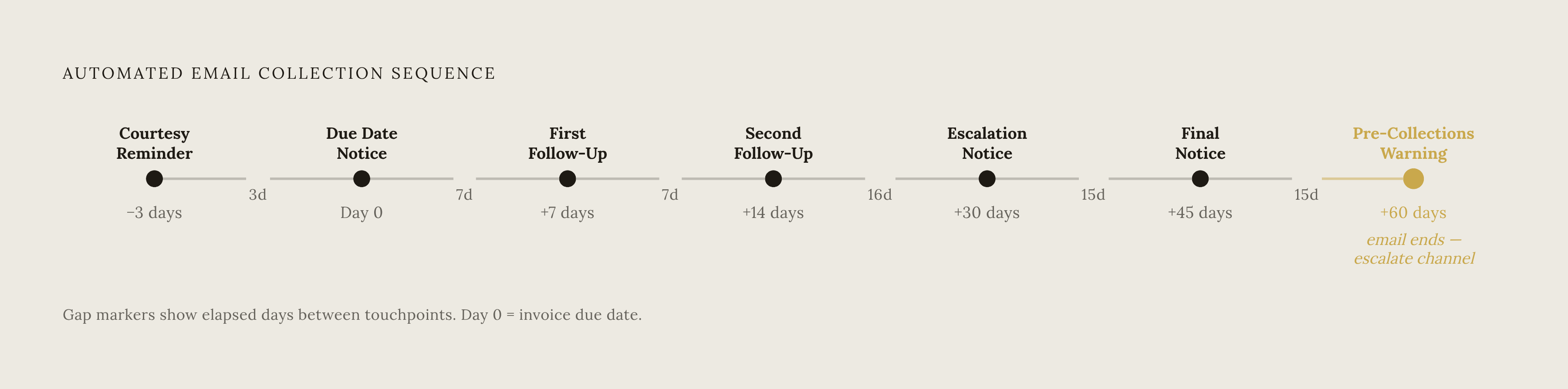
A well-built automated sequence does the heavy lifting before a human ever needs to step in. A courtesy reminder goes out 3 days before the due date. A notice lands on the due date itself. A first follow-up arrives at 7 days past due, a second at 14 days, an escalation notice at 30 days, a final notice at 45 days, and a pre-collections warning at 60 days or beyond. That rhythm resolves the largest share of overdue invoices without anyone picking up a phone, which makes it the highest-return activity in the early window of any receivables book. Tone matters here almost as much as timing. A reminder that sounds panicked at day 3 has nowhere to go by day 45.
The advantage runs out for a structural reason, not a bad-luck reason. Inboxes fill up. Open rates and response rates decline as an account drifts further past due, the same way a text you sent three weeks ago gets harder to justify replying to with each passing day. Sending the same channel at an aging account doesn't just fail to help. It burns time while the invoice keeps sliding toward the point where it becomes much harder to collect.
Collection probability as invoices age
Collection probability doesn't fall off a cliff. It slides down a curve, and every week an invoice spends in the wrong channel pushes it further down that slope. A finance team still running the same email sequence deep into the delinquency window isn't being cautious or thorough: it's spending the window where a phone call or a different kind of nudge would still have a real shot at bringing the money in, and getting nothing for it.
That cost is visible in hours: a 2024 roundup citing Xero found small-business owners spend roughly five hours a week chasing unpaid invoices. Five hours a week is a part-time job, and if those hours go toward resending an email that's already been opened twice and ignored twice, the curve keeps steepening while the clock keeps running.
Age by itself is a blunt tool, and it shouldn't be the only thing driving the decision. Balance size matters. So does the value of the customer relationship, whether a dispute is already on the table, and whether the paperwork behind the invoice is even complete. Age sets the floor for when a business needs to act. The next question matters more: what specific, observable signals tell a team the floor has been reached?
The four observable signals that mark the point where email compounds delay
Four signals mark the point where continuing to email stops being useful. None of them depend on how frustrated the AR team feels. Each one is something a finance team can actually see in its own data.
The first signal is an aging threshold crossed with no payment and no committed response. Most businesses draw their own internal line somewhere in the two-to-three-month range past due, after several contact attempts have already gone out. Past that point, continued email effort inside the finance team costs more in time than it recovers in cash. The distinction that matters here is what counts as a real response. "I'll check with accounting" is not progress. A committed response looks like an actual payment, a verified remittance, a signed payment plan, a documented dispute with evidence attached, or delivery of whatever AP document has been holding things up.
The second signal is a non-response pattern: the customer opens the email, every time, and never replies. The customer opening every email without replying is proof the message is landing somewhere, just not landing with enough weight to prompt action. A customer can respond politely to every single email and still make zero actual progress on the invoice. What matters is how many of those replies turn into a dollar moving, not how many replies come back.
The third signal is portal friction: the customer is a portal-first buyer. Large enterprise customers running procurement platforms like Coupa or Ariba require invoice submission, status checks, and dispute resolution to happen inside those portals. Coupa's own supplier documentation confirms this directly: invoices get submitted and disputes get resolved inside the Coupa Supplier Portal, not through a side conversation in someone's inbox. Email sent to a contact who has no ability to approve payment outside that system is wasted effort, no matter how well the email is written. The tell here is a portal login with no payment action behind it, or a status that reads "pending approval" and hasn't moved in weeks.
The fourth signal is a missing document blocking payment. A W-9, a purchase order number, a certificate of insurance, or a vendor onboarding form sitting unresolved in an AP queue stops payment cold, regardless of how many reminder emails go out asking for it. This one is easy to mistake for stubbornness when it's really just paperwork. The customer may be completely willing to pay. The obstruction is a process problem sitting in someone else's queue, and clearing it takes navigation, not another nudge.
Which channel to move to for each signal
Each signal points to a different next move, and treating them all the same way is where a lot of escalation ladders fall apart.
When the signal is aging past due with no payment committed, the right move is a direct phone call to the AP contact. A phone call forces a live answer, surfaces disputes that have been sitting quietly, and reaches people who've mentally filed the invoice under "later," something email structurally can't do.
When the signal is a non-response pattern, opens without replies, the move is to shift the next touch to a second channel while referencing the prior email. Send the email on day one. If it gets opened but not answered, don't resend the same message. Move to a phone call or, in B2B accounts receivable specifically, a LinkedIn message or direct note to the decision-maker. A message on a different channel carries a different kind of social weight than the fourth email sitting in an inbox that already has 40 unread messages in it.
When the signal is portal friction, the fix lives inside the platform, not in another email. Someone needs to check the invoice status inside Coupa or Ariba, respond to any RFIs sitting there, resubmit with corrected PO references if that's the issue, or escalate through the portal's own workflow. This is operational navigation, closer to knowing which door in a building actually opens than to writing a persuasive note. An AR team that treats every portal-stalled invoice as an email problem will underperform consistently on its enterprise accounts, because the invoice was never going to move from an inbox.
When the signal is a missing document, the move is targeted: identify the exact document that's missing, find out specifically who at the customer's company needs to supply or approve it, and contact that person directly. A generic message to a shared AP inbox just adds another unread item to the pile that caused the problem to begin with.
One more channel sits at the end of the line for invoices that have aged well past the earlier thresholds with no resolution in sight: third-party commercial collections. It's a last resort, reserved for accounts where every earlier signal and every earlier channel has already been exhausted.
Structured escalation versus ad hoc channel decisions
Knowing the four signals only pays off if they feed into a sequence a team has already committed to, rather than a judgment call made fresh on every aging invoice. A formal written demand letter, sent by email and certified mail together, resolves an additional 10 to 20 percent of overdue accounts, the same benchmarks found. Those numbers don't come from having better tools. They come from not re-deciding the same question every single time an invoice crosses a line.
Without a pre-committed sequence, a finance team relitigates the channel decision on every aging account, and that hesitation has a cost of its own. Relitigating the channel decision produces inconsistent tone, inconsistent timing, and a general sense, from the customer's side, that nobody on the other end is actually tracking the invoice closely. An informal check-in at the wrong moment signals the opposite of urgency. A precisely timed message on the right channel signals that the business is paying attention, and that principle holds across every channel in the sequence, not just inside email.
Tratta's 2026 collections practice guide notes that high-performing AR teams track DSO and aging buckets continuously, letting them prioritize early accounts before they age into the expensive stretch of the curve. The sequence works because it's informed by that ongoing visibility, not because someone glances at a calendar once a month.
A fair objection to all of this is that a rigid day-count schedule ignores the real differences between accounts. Account segmentation does matter. A broken payment promise or a sudden loss of contact justifies moving faster than a generic 60-day mark would suggest. But a structured sequence and account-level judgment aren't competing ideas. The sequence is the default path every invoice follows. Behavioral signals, a broken promise, a contact gone quiet, a dispute that surfaces mid-stream, are the override conditions that speed that default up. The signals from earlier sections are the inputs. The sequence is the architecture that decides what to do with them, every time, without a debate.
The operational risk of switching channels without a unified process behind them
Adding channels helps only if every channel feeds the same process. Running email through one tool, logging call notes in a spreadsheet, taking payments through a separate portal, and sending demand letters through a third system creates blind spots that cancel out whatever response-rate gains the extra channels were supposed to deliver. Cash comes in the door, but the follow-up stays manual, promises made on a call go untracked, and cash application slows down because nobody updated the master record.
Picture the failure mode directly: a customer pays through the procurement portal on a Tuesday, and the collections system, running off a separate record, still fires a collections call on Wednesday because the payment hasn't been reconciled to the account yet. That call doesn't read as diligence to the customer. It reads as a business that doesn't know its own books, which is a strange way to ask someone for money.
AR best-practice guidance is specific about where this comes from: when channels run through separate systems, blind spots build up, and the entire payoff from running multiple channels depends on having one unified view of communication, payment status, and account history in a single place. Without that, more channels just means more places for the same mistake to repeat.
Self-service portals look like a problem and often aren't one. Self-service portals are absorbing a growing share of routine payment activity. A customer who's gone quiet on email and is instead logging into a portal to pay directly isn't necessarily a non-responder. They may simply prefer resolving things in the portal. A team that can tell a stalled customer apart from one who's simply chosen a different, perfectly functional channel avoids escalating an account that was never actually a problem.