Building a Collections Escalation Policy for a Lean Finance Team
Swift escalation timelines and named decision-makers protect cash flow when margins are thin.

Late payment has stopped being an occasional headache and become the default condition of doing business, with the 2026 Small Business Late Payments Report finding that a majority of businesses now carry invoices overdue by 30 or more days, a sharp increase from the prior year. A credit policy governs whether and how much credit is extended and is owned by finance before the invoice is issued, while a collection policy governs what happens after an invoice is past due and is owned by AR. A single slow-paying customer can ripple straight into payroll timing, strain supplier relationships, and freeze any plan to reinvest in the business, because there's no reserve sitting around to absorb the wait. Without a defined process, overdue accounts get handled differently depending on who happens to pick up the phone that day, aging reports pile up, and disputes drift without anyone officially responsible for them, so the team stays busy without actually closing anything out. Dun & Bradstreet's collections policy guide makes the point directly: smaller companies with tighter margins can be hit hardest by delinquent accounts, and that exposure calls for tighter timelines and faster escalation to senior management, not slower ones. A lean team doesn't get the luxury of a relaxed collections posture just because it's small. If anything, it needs the opposite.
What a collections escalation policy is and what it is not
An escalation policy functions as a workflow that forces decisions to happen on schedule, so no single person has to rely on gut feel about when to pick up the phone or send a formal letter. A lot of businesses already have something they call a policy, but it lives in a manual nobody opens rather than in the daily workflow collectors actually follow, distinct from a related but separate piece of machinery: the credit policy. A credit policy governs whether credit gets extended at all and on what terms, and finance owns it before an invoice ever goes out the door. A collection policy governs what happens after that invoice goes unpaid, and AR owns that part. Keeping those two frameworks connected but distinct prevents the kind of confusion where nobody is sure who's supposed to act once an account tips into delinquency. For a collections escalation policy to do real work instead of sitting on a shelf, it needs exact contact timing tied to specific day ranges rather than vague instructions to "follow up regularly." It needs measurable triggers built on invoice age, dollar amount, and customer history instead of a feeling that now seems like the right moment. It needs a named approval authority at each stage, spelling out who can offer a payment plan, who can authorize a credit hold, and who can send an account to outside collections. And it needs documentation standards strict enough that every contact attempt, every promise to pay, and every open dispute gets logged with a name and a date attached. Emagia's AR best practices and the Dun & Bradstreet guide both stress the value of a clear collections policy, and Emagia frames it as a roadmap with expectations spelled out for both the internal team and the customer. That symmetry carries real weight: if the seller's side is unpredictable about enforcing its own terms, customers learn fast that those terms are just a suggestion.
Before escalating: diagnosing why the invoice is late
A rigid escalation ladder runs into one obvious problem. The exact same symptom, an unpaid invoice sitting past due, can come from three completely different causes, and treating all three the same way wastes effort and can quietly wreck a good customer relationship. H.L. Hunt's B2B collections analysis breaks those causes into three buckets: a documentation problem, like a missing W-9, a wrong PO number, or an incorrect remit-to address; a genuine dispute, where the customer contests the charge outright; or a credit problem, where the customer simply can't pay right now. Documentation failures turn out to be the most common of the three, and from the outside they look identical to a dispute or a credit shortfall, which is exactly the trap. Throwing a documentation failure into a collections track wastes time, produces nothing useful, and can damage a relationship that a single corrected form would have fixed in minutes. The fix is to build a diagnostic question into that very first contact: figure out whether this is a dispute, a processing hiccup, or a missing document before deciding which path the account goes down. Dun & Bradstreet's own sample guidelines reflect exactly this logic. The first contact, at days 1 to 3 past due, confirms the invoice was sent, confirms no dispute exists, and sends an automated reminder. Dispute handling deserves its own lane inside the policy, starting before outreach even happens: clear out unapplied checks, unused credits, and any special terms sales promised but never entered into the system. If a dispute surfaces mid-contact, resolve it on the spot rather than letting a week pass waiting on a corrected bill, because that week adds unnecessary aging with no benefit to anyone. One objection to this approach is worth addressing directly: diagnosing the cause is not a reason to pause the clock. It's a first-contact action that happens while the clock keeps running, so if the root cause turns out to be a credit problem after all, the team hasn't lost a single day of escalation time.
The tiered escalation framework: what happens at each stage
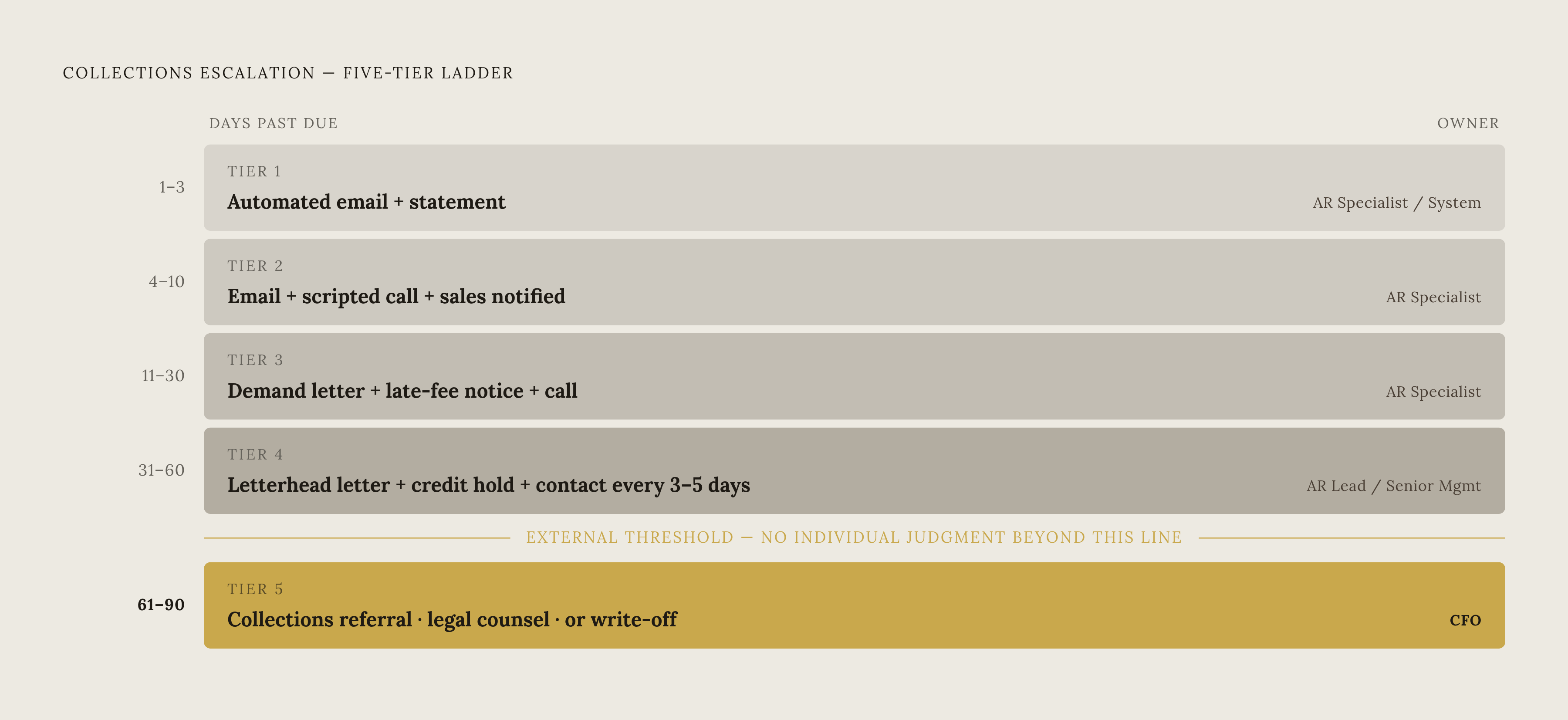
Tier 1. The tone here stays friendly and purely administrative. An automated email reminder goes out with the account statement attached, and the goal is to confirm the invoice was received, confirm no dispute exists, and confirm nothing is missing, whether that's a W-9, a PO number, or the right remit-to address. No human judgment is required. An AR specialist or an automated system runs this tier on its own, drawing on the same approach laid out in Dun & Bradstreet's sample guidelines and Eagle Rock CFO's AR best practices.
Tier 2. Follow-up gets more direct. A second automated email goes out, paired with a scripted phone call, and the sales rep responsible for the account gets notified that payment is now more than a week late. If Tier 1 flagged a documentation issue, this is where it gets confirmed as resolved; if it's still open, it gets treated as a dispute and routed into the dispute workflow instead of the standard collections track. An AR specialist owns this tier, with the sales rep kept in the loop, under Dun & Bradstreet's framework.
Tier 3. The account crosses into formal demand territory. A third automated email goes out stating that late fees apply after 30 days, backed by a phone call to confirm the customer actually got the message. This is the boundary Eagle Rock CFO describes as the shift from routine follow-up into formal collections, marked by the move to a formal demand letter. Every promise to pay gets logged with a date, and every unresolved dispute gets a named owner.
Tier 4. This is where credit holds and senior management enter the picture. A letter goes out on company letterhead stating the account is now 30-plus days late, and late fees apply per the agreed terms. The account goes on credit hold, which functions as a pause rather than a legal move: the message is "resolve this before more product ships," not an opening shot in litigation. Contact steps up to every three to five business days by phone and email. This framework draws on Dun & Bradstreet's guidelines along with the credit hold approach described by Buyers Intelligence.
Tier 5, days 61 to 90 past due. This is the external referral decision point. Once every internal recovery step has been exhausted, the policy needs to spell out the threshold for handing the account to a third-party collections agency, referring it to legal counsel, or writing it off, along with naming exactly who makes that call. Marcadis Law's wholesale distributor example illustrates what structure can do here: by pairing a defined escalation procedure with professional legal support, the company cut its average payment times significantly and reduced write-offs sharply. The structure produced that result, not any single person's judgment call in the moment. A CFO or equivalent owns this tier. No collector should ever make this call alone.
Escalation triggers that remove subjective judgment from the process
A tiered framework still leaves room for trouble if nothing but the calendar decides when an account moves up a level, because that puts individual judgment back in the driver's seat, and a lean team can't afford to lean on individual judgment for every decision. Emagia's AR best practices lay out the fix: escalation triggers need to run on specific, measurable criteria, namely invoice age, dollar amount owed, and the customer's payment history, so subjectivity gets designed out of the process. Three primary trigger dimensions every policy should define do the heavy lifting. Invoice age is the simplest of the three: it's the day-range thresholds already built into the tiered framework, non-negotiable and driven entirely by the clock, with no human assessment needed. Dollar amount works differently: a high-balance invoice should accelerate escalation past the standard age-based pace, because a large overdue balance carries more risk than a small one sitting at the same number of days past due. Customer payment history adjusts the path further still: a customer with a track record of late payments or prior bad debt moves through the tiers faster, while a customer with a clean history might earn a short hold before escalation if there's a credible explanation on the table.
None of this works without clear lines around who gets to act at each point. An AR specialist should be able to send a reminder, log a contact attempt, or flag a dispute without asking anyone's permission. A second phone call, a formal notice, or a recommendation to place a credit hold needs sign-off from the AR lead. A credit hold itself, a payment plan with adjusted terms, an external referral, or a write-off needs approval from senior management or the CFO. Spelling out authority levels this precisely is what separates a policy that actually runs as a workflow from one that just sits in a manual gathering dust, with collectors left guessing whether to act on their own or kick the decision upstairs. Sales will inevitably ask for exceptions to a credit hold, and the right governance response is a documented override request with a written justification and a named approver attached. If those exception requests start piling up, that's a signal the trigger threshold is probably calibrated wrong.