Onboarding a New AR Staff Member to an Existing Collections Process
Systematizing knowledge transfer prevents cash flow delays when collectors turn over.

Middle-market companies lose an average of 3.1% of revenue, roughly $14 million, to payment collection issues. A staff transition doesn't cause that problem so much as it hands it a megaphone. When someone walks off the AR desk, every account they touched loses continuity, and the new person inherits account records without the relationship context behind them.
What walks out the door when a collector leaves
Most collections teams keep the good stuff in someone's head rather than in the system. It's in someone's head.
Which customer always pays on the 45th day no matter what the invoice says. Who to call directly at a client's AP department instead of emailing into a void. Why that credit memo from March exists. The workaround for a supplier portal that logs everyone out after four minutes for no reason anyone can explain. None of it is written down anywhere the next hire can find it, because collections runs on relationships, and relationships don't fit neatly into a two-week handoff period.
So when the collector leaves, the follow-up cadence resets on every single account they owned. A customer who paid reliably because of a quiet, well-timed nudge now needs the new person to relearn the whole dance from scratch. That's how DSO drifts upward. That's how mistakes repeat on accounts that had known workarounds for exactly that mistake. And customers notice. They always notice when the person on the other end of the phone suddenly doesn't know their history.
The fix isn't complicated, even if it takes discipline to execute. Before the departing employee's last day, capture notes on every account. Assign every open promise and dispute to a named owner." Write the workarounds and escalation contacts into the account record itself, not into an email thread that disappears into an inactive inbox. And document playbooks while the outgoing person is still around to check that what's written down actually matches what they do. Keep the account record updated with notes and history so the next person inherits the relationship context, along with a ledger balance and a phone number.
The SOPs a new AR hire must be able to work from on day one
AR SOPs are written instructions detailed enough that any team member can do the task the same way when the usual person is on vacation, out sick, or gone for good. That consistency is the whole point. Turnover shouldn't change how the work gets done.
There are six SOPs that matter most:
Customer credit evaluation comes first, since it decides who gets credit and how much before a single invoice goes out. Invoice generation turns sales and service records into accurate, on-time bills. Payment processing records what comes in and updates the customer's account without delay. Collections management covers the follow-up procedures, the automated reminders, and the escalation protocols. Reconciliation matches the AR ledger against the general ledger on a regular schedule, and reporting produces the numbers on outstanding invoices, cash flow, and how healthy the whole process actually is.
One control has to be in writing, not just understood informally: billing and collections stay separate functions, collections and credit memos stay separate too, and only authorized users touch the billing software. Requiring this in writing keeps a clean audit possible and avoids a very awkward conversation later. It's the difference between a clean audit and a very awkward conversation later.
They write these SOPs from memory, in a conference room, weeks after the fact. That misses the workarounds, and the workarounds are often the knowledge most at risk of being lost. Shadow the person who does the task. Watch it start to finish. If the collections rep taps a shortcut key or calls a specific contact instead of the general line, that goes in the document, because that's the thing nobody remembers to mention out loud.
What the new hire must learn about collections before touching live accounts
Policy familiarity isn't a nice-to-have here. Applying collections procedures consistently is what directly minimizes payment delays and keeps cash flow moving. Skip this step and every account becomes a judgment call, which is exactly what a structured process is supposed to prevent.
Three skill areas need to be covered before a new hire dials a single customer. Negotiation and persuasion: knowing when to push for payment and when to offer a payment plan instead. Clear, professional communication, since collections language should never sound threatening, no matter how overdue the account is. And ethics, which matters less as a compliance checkbox and more because it's what keeps a slow-paying customer from becoming an ex-customer.
The dunning sequence is a system, not a vibe. It starts with a soft reminder shortly after the due date and escalates through progressively firmer contact. Teams that keep DSO low treat this sequence with defined thresholds, clear ownership at each stage, and a hard stop that triggers a real consequence. A new hire needs to know exactly which step belongs to them and exactly when to hand it off. Ad-hoc judgment calls are how a 30-day-overdue account quietly becomes a 90-day-overdue account nobody flagged.
Disputes deserve the same rigor. Respond fast, respond professionally, and have a clear path for escalating anything complicated. Quick, professional responses and a clear escalation path are both important elements of effective dispute handling.
The KPIs a new AR hire must understand from week one
The standard metric set typically includes Days Sales Outstanding, the Collections Effectiveness Index, Average Days Delinquent, the Bad Debt to Sales Ratio, AR Turnover, and the percentage of high-risk accounts in the portfolio. Increasingly, finance teams also track Customer Satisfaction scores and staff productivity, because collecting faster while torching the customer relationship isn't actually a win.
DSO deserves the spotlight, though. The Credit Research Foundation's Q4 2025 report put the broad domestic trade receivables median at 40.50 days, which is a useful cross-industry yardstick even though it flattens a lot of real variation. In many industries, 30 to 45 days is widely cited as a good benchmark, but the range swings hard depending on the business. Retail and food service run low because so much of it is cash-driven. SaaS is in a moderate band. Manufacturing runs higher, and construction is often the outlier, frequently pushing past 60 days without anyone blinking.
Rising DSO is a warning light, not just a number that moved. It can point to credit policy problems, customers in genuine financial trouble, or follow-up that isn't happening on schedule. Tying onboarding goals to DSO movement gives a concrete, measurable way to check whether the ramp is actually working, rather than just assuming it is because the new hire seems busy.
High-risk account awareness belongs in week one too. Knowing which accounts are flagged lets a collector focus energy where it matters most, which prevents bad debt and, somewhat counterintuitively, often opens the door to a stronger relationship with that customer. A new hire benefits from reviewing the risk profile of accounts in their portfolio early, so context is in hand before outreach begins.
Structuring the 30-60-90 day ramp so the portfolio stays healthy throughout
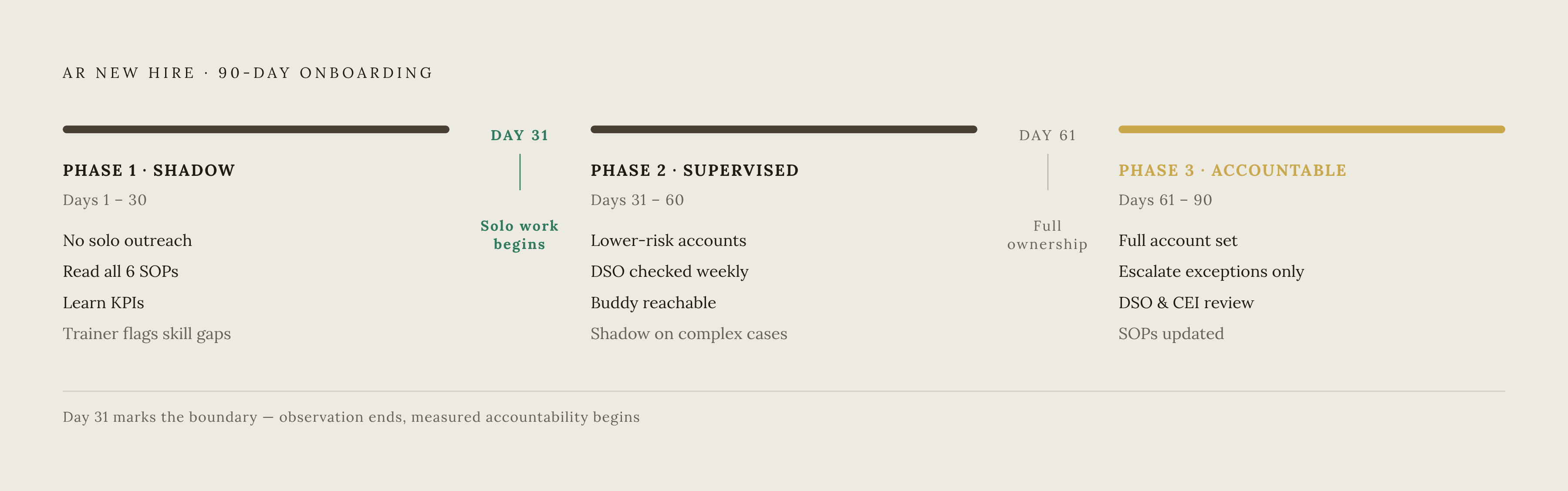
Ninety days is the standard window for onboarding, though some programs stretch to a year. Either way, training doesn't stop at day 90, it just changes shape. Structured onboarding isn't a soft perk, either: it increases new hire retention by 82%, improves productivity by 70%, and makes employees 58% more likely to stay three years or longer. Those aren't small margins.
Days 1 to 30, the foundation phase, is about watching, not doing. The new hire shadows an experienced collector on live accounts, sits in on dunning calls, learns the payment portals, and observes how disputes actually get handled in practice rather than in theory. They read and familiarize themselves with all six core SOPs. They learn what each KPI means and how the team actually tracks it in its own systems. No solo outreach yet. The trainer's job here is to spot skill gaps early and shape the rest of the ramp around them, not wait until day 60 to notice something's missing.
Days 31 to 60, supervised contribution, is where responsibility starts creeping in, deliberately and slowly. Account handoff should be gradual, recognizing that there's a real learning curve and rushing it just creates new mistakes. The new hire starts working lower-risk, simpler accounts solo, escalating anything unusual. DSO movement on their assigned accounts gets checked weekly. A buddy or mentor stays reachable for informal questions, because not every question deserves a formal meeting. Job shadowing continues for the trickier scenarios, similar to how a financial services firm might pair a junior analyst with a senior portfolio manager for a few weeks to sit in on client meetings and watch real decisions get made in real time.
Days 61 to 90, full ownership with accountability, is the point where training wheels come off. The new hire owns their full account set. The escalation path still exists, but it's for genuine exceptions now, not every unusual email. This is also when the first formal performance review happens, measured against DSO and CEI benchmarks. Whatever process gaps the new hire stumbled into during the ramp should update the SOPs, since fresh eyes catch undocumented workarounds that everyone else stopped noticing years ago. And this is not the moment to quietly close the onboarding file. Roughly 35% of employees say they'd quit a job without training opportunities, so day 90 should signal more development ahead.
Extending onboarding support through the full first year increases retention by 25%. The 90-day plan is a milestone. It was never meant to be the whole story.
Where AR automation fits into the new hire's workflow
Most AR teams only manually work a fraction of their overdue invoices in any given week. The rest sit untouched because collectors are buried in escalations and disputes and simply don't have the hours to chase every account personally. Automation exists to close that gap, not to replace the collector.
What automation typically handles is the repeatable stuff: sending invoices and payment reminders on schedule, routing straightforward follow-ups, and flagging overdue accounts so a human knows where to look. What it doesn't touch is anything requiring judgment. High-risk account management, decisions about a major customer relationship, negotiating payment terms, resolving a complicated dispute, that's all still collector territory, and probably always will be.
This division of labor needs to be spelled out explicitly during onboarding, not left for the new hire to guess at. If they don't understand where automation's job ends and theirs begins, one of two things happens. Either they duplicate work the system already handled, wasting time on an account that's fine, or they assume the system is covering something it isn't, and an account slips through untouched. Neither failure is dramatic on its own. Both are small gaps that quietly add days to DSO over a quarter.
Keeping collections performance stable while the new hire builds toward full productivity
Training isn't a one-time event that gets delivered and forgotten. It needs to be documented and maintained as a living record, with periodic refreshers for the whole AR team, including the newest hire. Feedback loops after training matter just as much: a new hire's observations during the ramp can surface whether the SOPs still match reality or have drifted from how work actually gets done.
The retention math backs this up. Research consistently finds that employees who rate their onboarding as exceptional are substantially more likely to say they're extremely satisfied, and satisfaction tracks closely with whether they stick around. Retention isn't just about what the ramp covers on paper, it's about how the experience actually feels while living through it.
Managers have a few concrete levers to protect cash flow while the new hire climbs the curve. Keep the high-risk, high-value accounts under a senior collector, or share ownership, until the new hire has proven they can run the dunning process without hand-holding. Check DSO on their assigned accounts regularly during the supervised contribution phase, and step in before a small drift becomes a real problem. Track CSAT on accounts the new hire has touched, since customer satisfaction is a dimension of AR health that payment speed alone won't capture. And set a hard escalation trigger: when a dispute reaches a point where it exceeds the new hire's authority or experience, a clear path to a senior owner should already be defined. Nobody's judgment should carry that weight alone in week six.