When AI Follow-Up Hits a Wall and a Human Has to Take the Call
Human collectors must take over when AI hits disputes, financial distress, or persistent silence.

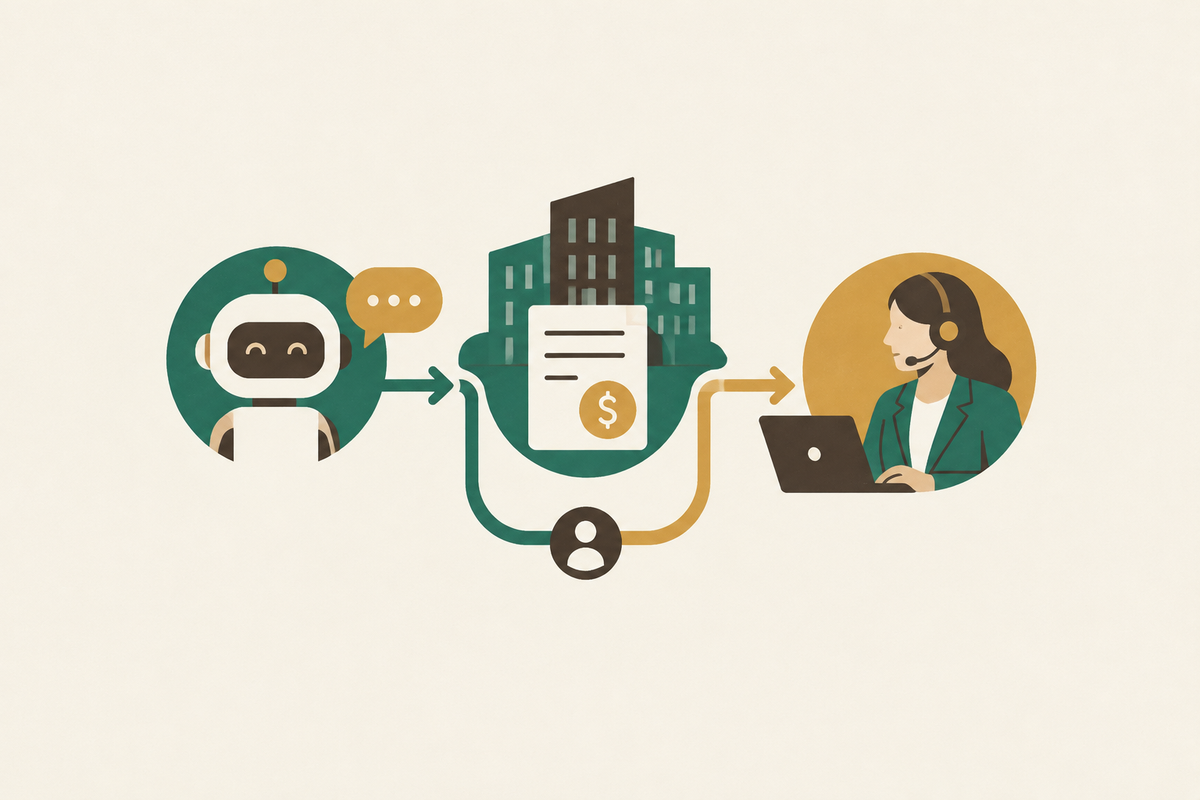
AI plus human collections follow-up for B2B accounts receivable works best when automation handles routine outreach and people take over disputes, financial distress, sensitive relationships, and persistent non-response. The practical skill is designing that transfer so the person receives the account’s history along with its overdue balance. When AI follow-up hits a wall, a human should take the call without making the customer start again.
Why AI follow-up has a structural ceiling in AR collections
One AR specialist can manage only so many accounts. When invoice volume grows without matching headcount, follow-up quality slips across the portfolio. Automation addresses that constraint by scoring payment risk, personalizing reminder cadence, timing outreach to behavioral signals, and escalating accounts that have not responded. Collectors can then focus their work on the exceptions.
Scripted logic works when the steps are predictable, but real AR portfolios always have some accounts that do not follow those steps. Prompting payment through timely reminders and settling conflicting records require different capabilities, making the design of the human role as important as the reach of the automation.
The four situations where scripted logic meets unscripted complexity
Disputed amounts create a conflict of evidence. A short payment with conflicting purchase order records requires someone to retrieve the documents, review what was ordered or delivered, and decide whether to approve or contest the deduction. Automated deduction management can triage that work. It cannot autonomously resolve the conflict when the records themselves disagree, because the next step is a judgment about the claim.
Genuine financial distress creates a different problem. Delayed partial payments or an explicit hardship message can signal that the customer needs flexibility. Changed contacts can also warrant investigation, although they do not establish distress on their own. A human’s job is to understand the situation and find a workable response, because escalating pressure at this point increases the risk of complaints, opt-outs, and permanent disengagement.
A strategic account disputing a milestone is not simply another balance in a 30-day aging bucket. The long-term partnership shapes how the disagreement should be handled, even though the invoice is still overdue. An automated cadence cannot weigh that trade-off, and treating the account like an ordinary late payer can put the collections objective at odds with the relationship.
Refusal to engage with automation creates a channel problem. Some contacts will not respond to automated email, portals, or SMS, however carefully the messages are timed. Silence can also hide an operational break, such as an AP contact who has left the company. The system sees non-response, but a person must distinguish an unreachable contact from someone avoiding the medium itself.
What the evidence says about human versus AI performance at the moment that matters
Yale School of Management analyzed roughly 22 million collection cases and found that borrowers contacted first by an AI caller repaid less and broke repayment commitments more often than borrowers handled by people. Later human follow-up did not fully close the gap. The evidence concerns borrowers, so it should not be treated as a precise forecast for every B2B portfolio.
People are less likely to keep a promise made to an AI agent, which helps explain why reaching someone does not always lead to payment. On a sensitive or disputed account, that distinction becomes especially important because the interaction already requires trust or judgment.
Klarna illustrates the reversal dynamic at service scale. In March 2024, its AI assistant was handling the equivalent of 700 full-time agents’ workload. By May 2025, CEO Sebastian Siemiatkowski said cost had been “a too predominant evaluation factor” and “what you end up having is lower quality,” as the company announced a return to human hiring. A spokesperson nevertheless described Klarna as “very much still AI-first.” Cost and capacity were insufficient measures of service quality.
Reversing a staffing decision also takes time. Once a service workforce has been dissolved, rebuilding a function of meaningful scale takes many months. Plans for full automation rarely count the time it takes to rebuild the team as an operating cost. For AR teams, the lesson is to retain a defined human capability for difficult accounts rather than assume it can be summoned when the queue becomes uncomfortable.
Why the handoff itself is often where the damage happens
An escalation can be correct and still arrive badly. When AI transfers an account without the conversation history or the reason for escalation, the collector has to approach it as a fresh contact. The customer then repeats the disputed amount, the missing document, or the explanation already supplied. On an already sensitive account, that reset can delay recovery and make it harder.
What the AI said and when is part of the account’s current state, as is what the customer said in response. The reason the system stopped also belongs there, because an unresolved documentation dispute calls for different work from unanswered outreach. Without those distinctions, a queue item tells the collector who owes money but not what needs solving. A balance is not a briefing.
This makes the handoff an operational design problem. It is a workflow state with information that must survive the transition and an owner who must act on it.
What makes a handoff effective rather than a reset
To avoid that reset, teams should design the handoff as a discrete workflow with its own inputs, outputs, and ownership. The collector needs a briefing packet with the invoice history, the full AI outreach log, the customer’s responses, and the escalation trigger. It should also identify disputed amounts, missing documents, and any relationship sensitivity. A queue item is not enough on its own. The packet should explain both the account’s history and the reason human judgment is now needed.
Escalation criteria should be specific and defined in advance. “The account hasn’t responded” leaves too much interpretation to the next person. A more useful condition is that the account is 45+ days overdue, has sent two replies indicating a documentation dispute, and has received contact attempts on three separate channels without resolution. That example combines age, evidence, and failed attempts to resolve the issue.
The human opening should then acknowledge the prior exchange. Referencing the earlier outreach and the customer’s stated problem shows that the collector is informed and that repetition is unnecessary. That removes friction at precisely the point when another generic demand could prompt disengagement. For an account in genuine financial distress, the first objective should be stabilization. The collector should establish that the company understands the situation and is open to a workable resolution before stating terms.
A missing W-9, purchase order mismatch, or supplier portal submission error is an obstacle to payment that should be resolved before payment pressure increases. Clearing the obstacle is often faster than repeating the demand. The handoff is effective when it changes the work from sending reminders to resolving the condition that made those reminders fail.
Where regulation draws hard lines that AI cannot cross alone
The legal boundary depends on the scenario and rule. Consumer debt-validation requirements should not be applied to all B2B receivables. Regulation F § 1006.38 requires the debt collector, for covered validation requests, to cease collection and send written verification of the debt. It does not expressly mandate human review or prohibit automated handling. Formal disputes and cease-and-desist notices also need more than the usual response to a reminder reply, but what the law requires in each case is separate from a claim that a person must handle every case.
The UK’s Data (Use and Access) Act 2025 explicitly gives people access to human review for automated decisions that fall under its rules. Its main data protection rules, including automated decision-making rules, have been in force since 5 February 2026. A solely automated decision that significantly affects a person requires safeguards, including informing the individual, allowing representations, providing access to human review, and allowing the outcome to be contested. Here, access to review is not optional. Opacity creates governance risk because the organization absorbs liability for contact or treatment decisions it cannot explain or trace.
How do you automate B2B collections without losing the human touch?
The workflow should begin with a division of labor. AI handles volume, consistency, cadence, simultaneous multi-channel outreach, portal navigation, payment tracking, and escalation scoring. People handle disputed invoices with conflicting documentation, distress signals, strategic relationships, and customers who will not engage through automated channels. That account set gives human work a defined purpose. It avoids treating people as either a backup for every overdue invoice or a last resort after every automated option has been exhausted.
Teams should plan how to hand over those accounts before they start the outreach. Each escalation signal needs a corresponding information packet and a named owner from that point onward. The packet supplies continuity, while ownership makes clear who is responsible for the unresolved issue. For customers who stop responding to reminders, the human task is to establish whether the obstacle is the contact, the channel, a dispute, or the ability to pay.
Platform selection should follow those workflow requirements. An always-on execution layer can follow up, navigate portals such as Coupa and Ariba, respond to customer questions, and escalate with full context when judgment is needed. Reminder volume alone is a poor comparison criterion. The useful distinction is between software that passes over an overdue account and software that passes over the information needed to resolve it.
Cash collected per account worked and time to resolution on escalated cases show whether the combined workflow produces results. The share of accounts handled fully and correctly without a human shows where automation saves work. Automation rate alone cannot distinguish a resolved invoice from an unresolved account still receiving immaculate reminders.
The goal is not to keep a human on every account, but to have an informed human ready when the next useful step requires judgment.