Hybrid Collections Platforms That Route Enterprise AR From AI Follow-Up to Live Agent Escalation
Platforms that hand off AR cases to humans only when AI hits its limits recover more invoices.
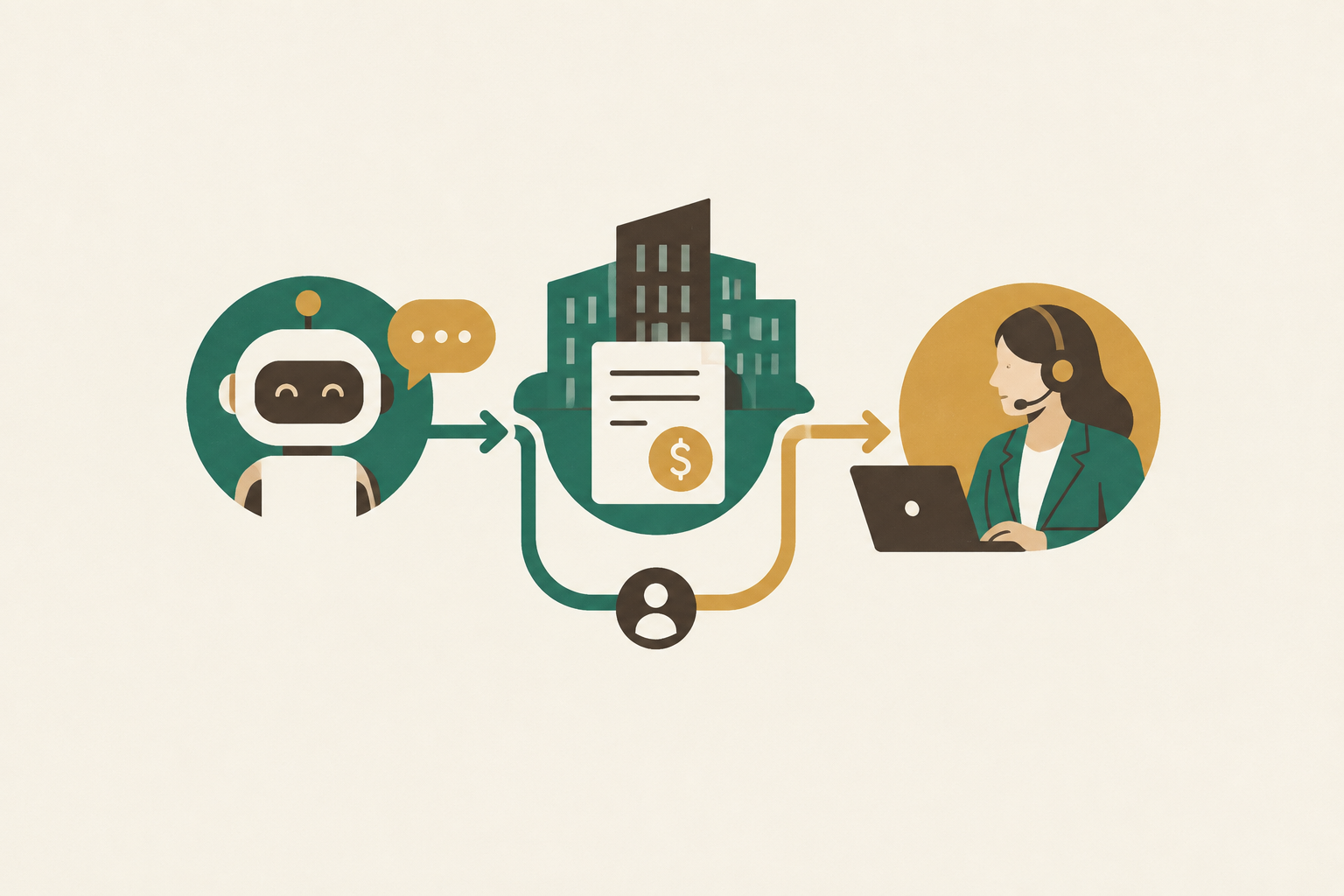
AI plus human collections follow-up for B2B accounts receivable works best when the platform defines exactly when automation must stop and a live agent must take over. AI handles routine conversations, while people handle disputes, sensitive relationships, and unresolved workflow blockers. The decisive feature is not how many reminders a platform sends, but whether its handoff logic turns stalled invoices into resolved accounts.
Why AI-only or human-only AR collections fails enterprise B2B at scale
Enterprise collections has a capacity problem and a judgment problem. Median B2B days sales outstanding sits at 56 days across industries in industry benchmark data. Teams that do this work by hand cannot give every overdue invoice the same attention, and they do not always make the same decisions. When experienced collectors leave, undocumented knowledge of customer behavior leaves with them. The handover rarely includes a complete map of who pays only after which conversation.
Rule-based dunning addresses volume, but not understanding. It sends reminders through prescribed channels without interpreting what customers send back. A request for an invoice copy, a dispute, and silence require different actions, yet a system that cannot read replies cannot make that distinction. More reminders just give the void a fuller inbox.
First-generation AI improved predictions without removing the execution bottleneck. It scored accounts, forecast payment dates, and suggested what to write back, but a person still sent each answer. Disputes, portal rejections, and unmatched payments continued to land in human inboxes. An invoice rejected silently by a procurement portal three weeks earlier could remain unacknowledged until it reached ninety days. The missing capability was not another prediction, but the ability to act on customer replies and portal failures.
What agentic AR actually does differently from earlier automation
Agentic AR moves from advising a collector to executing the two-way collections conversation. Agents can read replies, check ERP records and conversation history, and answer in the existing thread. They can also resend invoices, confirm payment status, chase small balances, handle bounced emails, capture PO numbers, route disputes, and match payments. The person no longer approves every routine step. Instead, human attention goes to exceptions and actions outside the agent’s authority.
The underlying architecture helps explain that change. An AI-added platform uses models to score and draft within a rules engine it already has, while an AI-native platform lets the agent decide, act, and log without that engine underneath it. Both approaches are legitimate, but they fail differently. For buyers, a useful starting question is what the product did before generative AI existed. A product that already ran the same workflow on rules has added AI to an existing foundation.
Paraglide AI’s Collections Agent illustrates agentic execution at Spiideo. It handles the two-way conversation from first reminder to debt recovery, follows up in existing threads, and resolves 40% to 90% of routine billing enquiries autonomously. Humans step in for disputes and key accounts. That division reflects an autonomy ladder. In well-designed deployments, key-account replies, dispute responses, credit notes, refunds, master data changes, and collections escalations still require human approval.
The escalation trigger set: the signals that tell a platform when AI has reached its limit
An agent’s ability to answer does not establish its authority to continue. The trigger set must separate routine work from cases that need a human right away. Those triggers include dispute language, indications of bankruptcy or attorney representation, hardship or distress language, cease-communication requests, and any input the classifier cannot confidently categorize. Uncertainty is itself a reason to hand off. A confident-sounding answer is not a substitute for a confident classification.
When a distress or dispute signal fires, the system must route the account to a trained human and freeze further automated contacts while the escalation remains active. Contact resumes only after a supervisor confirms resolution. Otherwise, one part of the platform can keep chasing payment while another handles the dispute. The handoff also needs an evidence trail. It must record which signals fired, what the agent did, and where responsibility passed to a person.
Sidetrade’s Aimie illustrates how non-negotiable policies can sit beneath automated conversations. The agent identifies itself as AI acting on behalf of a human, states that the call is recorded, and offers an opt-out at any time. These are hard rules. They establish a floor of safeguards that apply regardless of configuration. The same architectural discipline makes escalation a defined state change.
Why compliance is an escalation design constraint, not an afterthought
A human collector can mishandle one dispute. A misconfigured agent can repeat the error across a campaign before anyone reviews an interaction. That asymmetry makes compliance a primary input to escalation design. Automated collections must have explicit limits on what the agent may say and do. Speed is less impressive when it accelerates the wrong behavior.
Under the guardrails described here, AI must not negotiate hardship, agree to settlements, make threats, or improvise around disputes. The legal context still needs care. The FDCPA provisions discussed apply to consumer debt rather than every B2B invoice, and its validation and cease-communication obligations have rules for written-notice and timing. Distress detection can therefore prompt a handoff to a person in more cases than a given statutory trigger requires.
The TCPA requirements described for AI voice calls to cell phones include prior express consent, identification of the responsible party, and a working opt-out. A manually dialing human sits in a different consent category. Substituting an AI voice agent is not legally neutral.
The NCUA’s 2026 examiner priorities embed third-party risk management in lending reviews, including outsourced servicing and collection functions. Examiners may assess oversight of a platform’s escalation behavior. For regulated lenders, vulnerability detection must therefore operate within the conversation layer, with immediate human escalation and preserved evidence. Outsourcing the conversation does not outsource accountability.
How the autonomy boundary differs by account type, relationship, and risk
Mandatory escalation triggers form the floor, but account characteristics determine how much freedom exists above it. Small balances, low-risk accounts, and repeat late payers with predictable behavior can remain autonomous through the routine cycle. Key accounts need a different arrangement. AI can draft, while a person approves tone and timing before sending. Accounts with a dispute history, complex payment terms, or multi-entity structures need a lower threshold for human review throughout the cycle.
Payment risk scoring supports this differentiation by using historical behavior to identify likely late payers and guide outreach timing. For ordinary payment chasing, human escalation follows when automated outreach has not worked. Mandatory dispute or distress triggers override that sequence. This keeps collectors focused while letting customers with disputes or signs of distress reach a person before the reminder campaign has run its course. A strategic relationship should not receive the same treatment merely because its invoice has the same age.
Mistras Group deployed several Aimie agents to contact customers, qualify disputed invoices, prioritize collection actions, and adjust strategies across thousands of accounts. Finance staff handle governance and exceptions.
OpenText’s VP Credit and Collections Stephen Dyer described the consistency benefit directly. “I manage 100+ collectors globally, and inconsistency is inevitable. Aimie guaranteed precise, repeatable execution which is a game-changer!” That figure describes his team. The enterprise value is a boundary applied consistently across accounts, rather than one each collector must reconstruct from memory.
The operational blockers AI alone cannot clear: portals, missing documents, and communication gaps
Not every stalled invoice contains a difficult conversation. Some never reach a payable state at all. A supplier portal such as Coupa or Ariba can reject an invoice because of a formatting or data error. Notifications may exist, yet go unnoticed when suppliers are not monitoring portal status fields. The seller keeps chasing an invoice the buyer’s process has not accepted.
Missing vendor documents create a similar blockage. The buyer’s AP team may need a W-9, insurance certificate, or banking details before it can release payment. Elsewhere, the invoice reaches the right company but the wrong contact, or its intended recipient has left. Short payments and deductions without remittance detail introduce another kind of uncertainty. An AI that cannot match them may leave them flagged as open, with the balance unresolved.
These failures need an escalation path of their own, separate from the one for disputes. Portal navigation, document retrieval, and direct contact with the buyer’s AP team are operational work. When an agent cannot complete that work, the handoff must reach someone who can. Another reminder is not a replacement for a missing W-9.
That distinction changes what successful routing looks like. Conversation signals show when AI should stop talking, while workflow signals show when talking is not enough. A hybrid platform needs both, or it can maintain an immaculate contact history while the invoice remains stuck.
What enterprise deployments show about where hybrid routing creates measurable value
Those gains concentrated in accounts where timing and channel selection had previously been inconsistent. Accounts that have been neglected or poorly handled have more room to improve than those already moving smoothly toward payment.
The same early adopters reduced manual follow-up work by more than forty hours per week and lowered AR operating costs by more than three quarters. These outcomes describe different dimensions of value. Reply rates show engagement, collections show recovery, and workload reductions show operating leverage. None alone establishes the whole case for a platform. A busy inbox can still coexist with unpaid invoices.
OpenText and Mistras point to another source of value, which is consistency across large collection operations. Their examples emphasize repeatable execution and the division between automated work and human exceptions. Large teams, turnover, and variable collection cadences create inconsistency, while a mixed portfolio creates competing demands on staff. Automation can handle large amounts of routine work without forcing truly complex accounts through the same narrow process.
What should finance leaders demand from a platform claiming hybrid AR routing
For finance leaders, the practical evaluation is a governance test. Buyers should first ask what the product did before generative AI existed, because its foundation helps explain its failure modes. The next is whether the vendor can show the exact human-escalation trigger set. A claim to offer “human support” is not enough. The platform must also show whether autonomy changes by account segment or is the same for every account.
The demonstration should then follow an account into difficulty. Buyers should ask what fires, what freezes, and what gets logged when a customer uses dispute language. They should separately ask how portal rejections and missing documents are handled, rather than accept an outbound email demonstration as proof. These are different tests. One exposes the conversation boundary, while the other exposes whether the platform can move blocked work forward.
The remaining questions concern evidence and continuity. Finance leaders should ask what record each escalation leaves, whether compliance disclosures are mandatory or configurable, and what the receiving human sees. Full conversation context and a summary are not interchangeable descriptions of a handoff. The vendor needs to show which it provides. Together, these questions reveal whether escalation is built into execution or attached as a fallback.
The governing standard is an agent pursuing an approved financial outcome within institutional policies, using live context, taking permitted actions, verifying results, and escalating exceptions. Efficiency follows from that design. The choice of platform must also take into account the team that handles portal navigation, missing documents, and contact with the buyer’s AP team. Even the strongest AI cannot make up for an escalation path that leaves no one in charge of the next step.