Why Drip Sequences Fail Silent B2B Payers and What Replaces Them
Silent payers are usually stuck, not stubborn, so fix the blocker.

AI plus human collections follow-up for B2B accounts receivable works when automation handles routine reminders and surfaces risk, while people resolve missing documents, portal rejections, and stale contacts. Drip sequences fail silent payers because they try to get the attention of someone who may be unable to act. The replacement is a process that identifies the blocker and clears it, rather than sending the same request on a different Tuesday.
Why drip sequences were built for a different problem than collections
A drip campaign assumes that reaching someone at the right moment can move them forward. After an entry event, messages fire on a schedule or in response to behavior, delivering relevant information until the recipient replies or converts. The sequence can branch, but it still relies on getting someone’s attention so they can act. Capture attention, and action becomes possible. That is a sensible design for nurturing a prospect whose main barrier is awareness or timing.
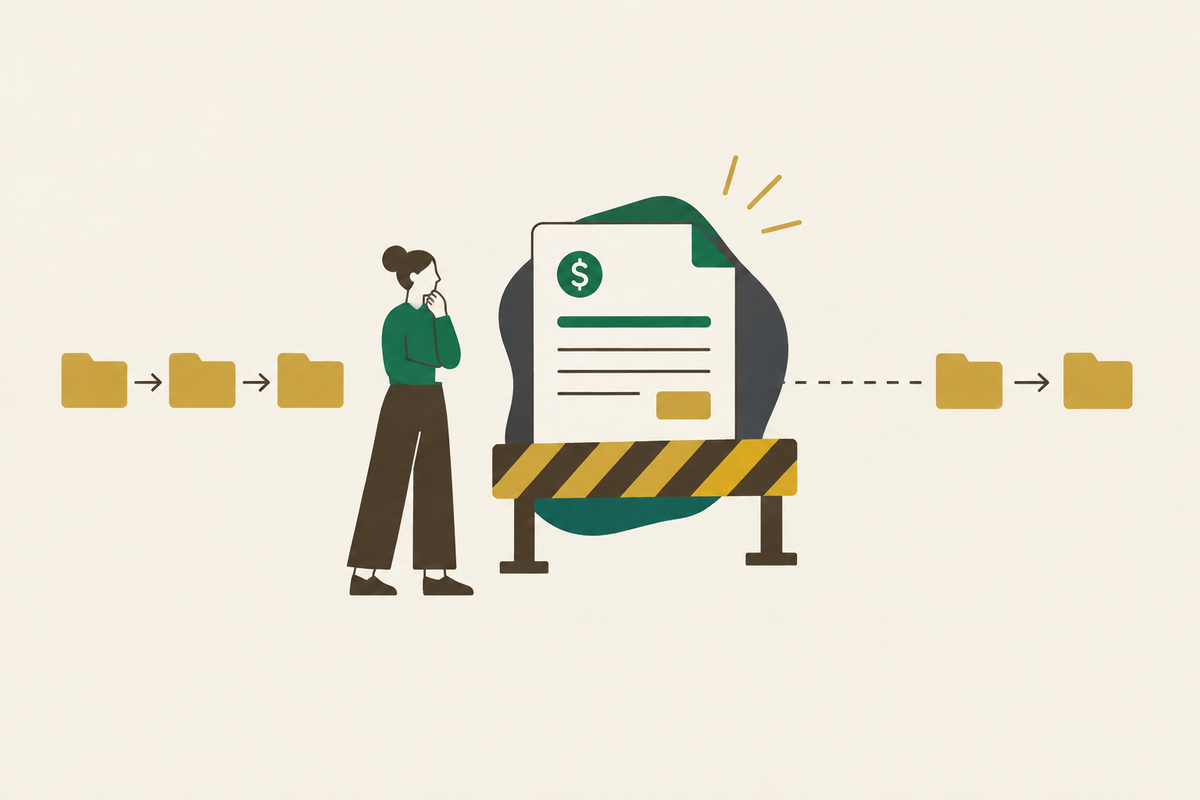
Collections starts from a different set of conditions. An accounts payable contact may already understand the invoice, accept the obligation, and want to pay. Yet payment cannot proceed if a required document is missing or the invoice has been rejected in a supplier portal. If the contact has left the company, even that description is too generous. There is nobody at the other end who can move the work along.
A clearer subject line might help someone notice a reminder, but it cannot provide a missing PO number. Nor can a more thoughtful interval put a rejected invoice into a payable state. A louder doorbell is little help at the wrong address.
The three structural reasons B2B payers go silent
Missing or mismatched documents can stop an invoice before the seller knows anything is wrong. An invoice without a matching PO number, a missing W-9, or a tax form in the wrong format can be rejected without notification reaching the seller. The AP team cannot take the next step to pay. Meanwhile, the drip keeps running because the silence gives no clue about which document is missing or who needs to provide it. There is no objection for a more persuasive email to answer.
Supplier portals create a separate operational barrier. Enterprise buyers may require invoices through Coupa or Ariba, where an incorrectly submitted invoice can be rejected silently. Until it is in the buyer’s system in a payable state, email outreach cannot advance payment. Coupa’s supplier portal handles onboarding and performance management, which can create friction for a supplier trying to submit a single invoice. Ariba’s SAP Business Network also charges suppliers a percentage of transacted volume above a threshold, with a higher rate for relationships involving service entry sheets and an annual cap per buyer relationship. Those charges make it harder to do business, especially for mid-market suppliers with thin margins.
The payment block can also sit on the AP side. Tipalti gives suppliers a self-service way to deal with missing tax details, an invalid bank account, or a sanctions flag. But someone must first surface the block. A reminder that simply asks when payment will arrive does not identify which detail needs attention.
Stale or wrong contacts complete the picture. People change jobs, companies are acquired, and domains are consolidated, leaving the original billing contact out of date. Manual supplier onboarding can make things worse when registration is late, documents are incomplete, and people have to keep following up. The email reaches the right company but the wrong human. Across all three conditions, the process is stuck rather than the recipient unconvinced.
How contact decay compounds the silence problem over time
A list that was accurate at the start of the year can be meaningfully wrong by mid-year, with messages bouncing, forwarding nowhere, or reaching a successor without context. AR teams often use the contact from the original deal or invoice. That record has no built-in guarantee of staying current. Time does not improve the address book.
A departed employee’s inbox exposes the weakness in reply-based logic. An email sent there may produce no reply, trigger no exit condition, and alert nobody that the contact is gone. It still counts as a send. As those sends accumulate, the activity log can look reassuring while the invoice keeps aging. Volume wears persistence’s clothes, and the team has little reason to distinguish them if outreach is the measure of progress.
This problem begins before manual collections visibly breaks under disconnected systems and stale reports. The underlying contact can already be wrong while the workflow still looks orderly. Reply rate then stops showing how willing the payer is to respond. Silence from someone who has left says nothing about the company’s intent to pay. It says the process has lost its route to a person who can act.
What the aging report reveals once the drip has already failed
An aging report makes the consequence visible after the sequence has had its chance. It organizes receivables by how long they have been outstanding, with a healthy balance concentrated in the current bucket and less in later buckets. A static report records elapsed time by showing that an invoice aged. It does not show whether AP is missing a tax form or never received a valid submission.
A sequence can run for weeks without a reply before the invoice appears as a risk item in a report reviewed weekly or monthly. By then, the cheapest window to fix the blocker has passed. The later bucket is evidence that the earlier process did not produce a diagnosis.
Payment Drift Analysis offers an earlier signal by monitoring subtle changes in payment behavior, such as a reliably prompt payer beginning to stretch their days. That shift can reveal a structural problem before it reaches the later aging buckets. Most drip-based approaches lack this view. As invoices get much older, the chance of collection falls sharply, so waiting affects both when cash arrives and whether it arrives at all.
Versapay’s case study says that Gulf Coast Panama Jack cut days sales outstanding by a large amount after switching from manual to automated AR and connecting the platform to Microsoft Business Central. The outcome grounds the value of changing the process. It does not make every automated send an improvement. The distinction is whether automation supports early detection and resolution or merely keeps dunning on schedule.
Why escalation timed to invoice age misses the point
Adding escalation steps does not fix a process that still goes only by the invoice’s age. Standard dunning can send the same template without distinguishing a missing PO from a genuine dispute or noticing that the recipient has changed. A sterner message adds pressure without adding knowledge. The calendar has advanced, but the diagnosis has not.
A large enterprise account with a prior dispute history calls for the account manager to be told early, while a small SMB with a clean multi-year history can stay in the automated flow longer. Days past due still have a role. They belong with invoice size, account tier, dispute history, renewal proximity, and whether the invoice sits in a portal system. None of those variables can be replaced by choosing a more alarming subject line.
A disputed line item should be put on hold and flagged for finance, while clean invoices from the same customer go through collections. The unit of intervention is the blocked item. Treating the whole account the same way can hold up valid invoices over a disagreement about something else.
Collections agencies sit at the far end of this escalation path, when the relationship is already gone. They typically charge a significant share of what they recover. That makes them a final step, after earlier efforts to find a missing document or the current AP contact. The alternative to the drip must therefore change how decisions are made.
How do you get past-due B2B customers to respond when automated reminders stop working?
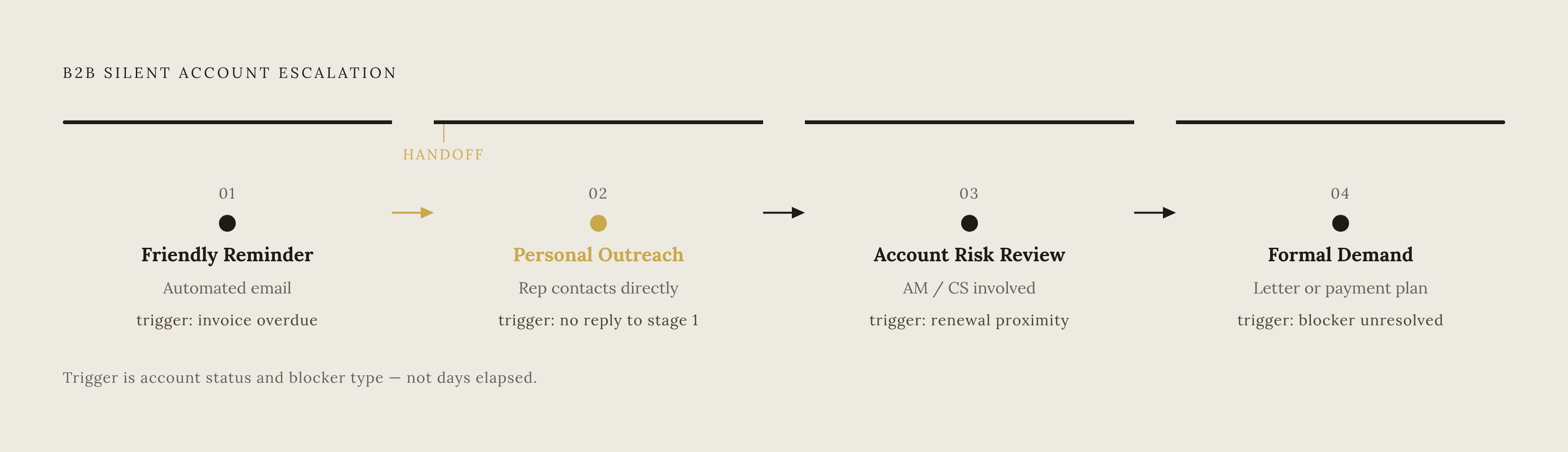
An operationally aware collections process begins by separating routine forgetfulness from a blocked payment. Pre-due outreach and an accurate, friendly reminder in the first days past due can resolve genuinely overlooked invoices without human escalation. Automation belongs in that lane. The failure comes from treating it as the whole road, with no way to investigate accounts that stay silent.
For those accounts, the next move is contact discovery. The recommended sequence is to check out-of-office replies and email signatures for redirect information, use external data enrichment to identify current finance and AP contacts, and then call the main line to locate accounts payable. Each move seeks a usable route to the buyer. Sending again to the original address does not find the person who can act.
Once the right contact is found, someone needs to be clearly in charge of the portal and document work. Portal navigation means submitting the invoice correctly, dealing with rejections, fixing documents, and checking status under the portal’s rules. Document resolution names the missing W-9, tax form, or PO mismatch, identifies the right internal or external contact, and confirms that the gap is closed before the invoice moves forward. “Following up” is not an adequate description of them.
Human escalation then moves through four stages based on what is happening with the account. A friendly reminder gives way to personal contact with a specific inquiry about the invoice, followed by account manager or CS involvement tied to account risk and renewal proximity. A formal demand or payment plan comes later in the process. These stages are not simply dates on a calendar.
Versapay is the AR automation platform in the Gulf Coast example, while Coupa and Ariba are supplier environments the collections process may need to navigate. Tipalti addresses complementary AP-side payment blocks through supplier self-service. Product category is not a substitute for workflow coverage. The useful criteria are whether the process can surface which accounts are at risk, why they are blocked, and what action is pending.
That is the practical division of labor for AI plus human collections follow-up. Automation keeps outreach consistent and provides collections intelligence, while people check contacts, sort out operational exceptions, and handle conversations that need care because of the account relationship. The human touch is useful because it changes the next action. Success is measured in accounts resolved, blockers cleared, and DSO movement.
What lean finance teams should build first
For a lean finance team, the first step is to audit current silent accounts before changing the outreach. Each account needs to be checked to see whether it is portal-blocked, document-blocked, or contact-stale. That answer determines the next task. A portal resubmission, a document request, and contact enrichment solve different problems, none of which calls first for a new email template.
The next priority is a review cadence before a detailed escalation playbook. Daily aging review, or real-time monitoring of payment drift signals, gives the team a chance to catch blockers while they remain cheap to resolve. Monthly review leaves it working from a lagging signal. Contact refresh deserves particular attention for accounts in the mid-aging bucket, before they reach later stages. At that point, the fix can still be a data task.
Without dedicated AR staff, steady follow-up also needs a process that runs without someone having to start it. Teams approaching the limits of manual collections should treat blocker detection and resolution as infrastructure. The immediate test is simple. For each silent account, can the process tell whether the invoice is blocked in a portal, missing a document, or unreachable through the contact on file?
If it cannot, the team’s next task is to find that answer before scheduling another send.