Getting a W-9 From a Vendor Who Ignores Requests
Track three mandatory solicitations and backup withholding steps to enforce W-9 compliance.

Getting a W-9 from a vendor who ignores requests is a compliance problem. The resolution is a documented path from requests to backup withholding to proper 1099 filing, with the first move shaped by why the vendor went silent.
Why a vendor's silence on a W-9 is your compliance problem, not theirs
The IRS requires the payer to report payments even when the vendor refuses to give tax information. The business trying to collect the form bears legal exposure for a missing return.
The W-9 itself never goes to the IRS. It stays in your records, but its taxpayer identification number, or TIN, supplies information for the 1099 that does go to the agency. Before payment, you still have leverage to get that information. After payment, the vendor has the money and you have an unfinished compliance task. The order of operations deserves as much attention as the follow-up wording.
Why vendors go silent, and why the reason determines your first move
Before sending another reminder, ask which problem you are actually trying to solve. Silence alone does not tell you the answer. A vendor who fears identity theft needs a different response from one who hopes the income will go unreported. Treating both as stubbornness wastes time and can turn a fixable concern into a strained relationship.
Explain how the form will be stored and point the vendor toward using an EIN as an alternative to an SSN where appropriate. Some small operators already have an EIN but do not realize it can address their concern. By contrast, a contractor new to self-employment may simply need a short explanation of the IRS requirement and directions to the form. Someone unsure about entity classification or which TIN to enter needs a brief walkthrough of that section, or a suggestion to consult their accountant.
Procrastination calls for a deadline tied to payment processing. The form may be sitting beneath everything else the vendor intends to do “soon,” that spacious calendar category. When a vendor is trying to avoid taxes, start with a backup withholding notice that explains how it will affect their payments. Explaining the rule will not help when the vendor already understands it and refuses to follow it.
The three documented solicitations the IRS actually requires
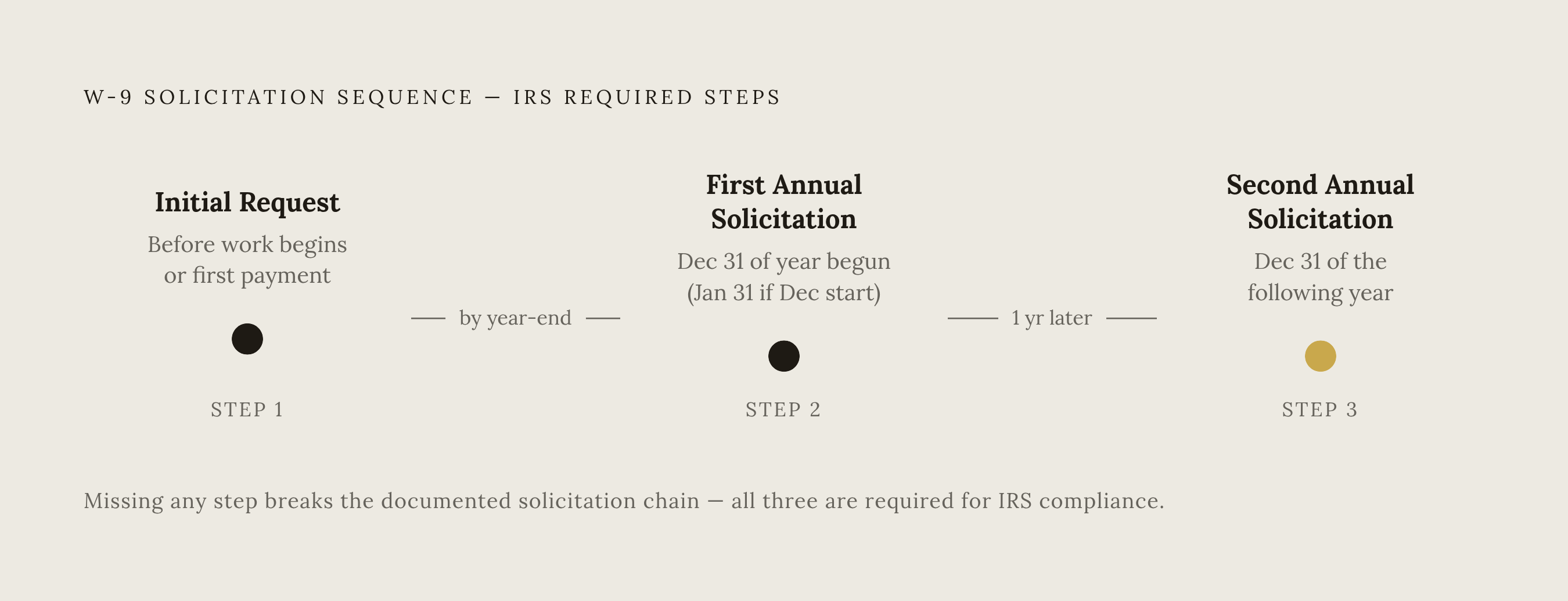
The IRS solicitation structure requires more than one email followed by a hopeful pause. Make the initial written request at the outset of the business relationship, ideally before work begins or payment is made. That request starts the record of your effort to obtain the TIN. It does not, by itself, complete the solicitation process for an ongoing relationship.
The annual deadlines are easy to overlook. The second request, called the first annual solicitation, is due by December 31 of the year the relationship began. If the relationship started in December of the preceding year, that deadline is January 31. The third request, called the second annual solicitation, is due by December 31 of the following year. These three solicitations are calendar-based obligations with deadlines governing when each message is sent.
For day-to-day follow-up, use a faster operational cadence without confusing it with that annual schedule. Send the initial request on Day 0. Send a first written reminder shortly afterward. Follow with another written reminder on Day 14. Send a final written notice with a backup withholding warning on Day 21. Day 22 and beyond can mark an operational escalation to a permissible payment hold or continued withholding. This cadence creates no grace period for payments already subject to backup withholding, and it does not erase the annual deadlines.
Keep the evidence with the vendor’s records. Keep every written request, the date it was sent, any reply, and a record of backup withholding applied. Email makes it practical to preserve the request itself, rather than rely on someone’s recollection of a conversation. A phone call does not count for B-notice solicitations involving an incorrect TIN, though it may be permissible in other TIN solicitation contexts. Written records help you defend against a penalty if the IRS later questions what you did.
When to notify the vendor that backup withholding starts — and what that notice does
An explicit backup withholding notice, optional under IRS requirements, is often the step that gets a response. Tell the vendor that 24% of every future payment subject to backup withholding will be withheld and sent to the IRS. A smaller payment tends to command more attention than another email marked “following up.”
Make the notice plain enough to survive a hurried reading. State that you have requested the form multiple times in writing and have received no TIN. Give the date withholding will start unless the form arrives, while making clear that the notice gives the vendor no legal waiting period. Explain that the withheld funds go to the IRS and can only be recovered by the vendor through their own tax return. If privacy is the obstacle, include the EIN alternative rather than treating the notice as a threat with no route to resolution.
The notice is persuasive, but withholding is an obligation. When required, withhold the amount from each payment, remit it to the IRS, and report it on Form 945. A payer who fails to collect the required withholding can be held liable for the uncollected amount. Backup withholding applies immediately to nonemployee compensation when required, even if the vendor says they have applied for a TIN and are waiting for it.
Withholding payment entirely as a pre-contract lever
A W-9 requirement written into the vendor contract as a condition of payment is the strongest preventive tool. Requiring the form before an invoice can be approved or a payment sent gives the vendor a clear reason to finish the paperwork.
An existing contract changes the legal picture, however. If it requires timely payment, holding back the entire amount may expose you to a breach claim even while the vendor refuses to supply a W-9. Treat a full payment hold as a contract-design choice.
You do not have to stop working with a noncompliant vendor. You do have to apply required backup withholding and report the payments properly. For future relationships, the lesson is to embed W-9 collection in onboarding before any invoice is approved or payment released. That tells the vendor what is required from the start and helps avoid a surprise dispute with finance when the vendor expects payment.
How to file the 1099 when the vendor still will not provide a TIN
A vendor’s refusal does not cancel a required Form 1099-NEC. File the return even when the TIN is missing. The IRS instructs payers to leave the recipient’s TIN box blank when the payee refuses to provide it. Do not enter “refused” or other explanatory text in that field.
Documented good-faith solicitations support the defense of a filing with missing information. They do not make skipping the return acceptable. Preserve those requests so that a blank field has an explanation backed by evidence, rather than an assumption that the vendor would eventually cooperate. Filing with a missing TIN and a documented effort to obtain it is a different position from failing to file at all.
A legislative change raised the Form 1099-NEC and 1099-MISC reporting threshold for payments made on or after January 1, 2026. That reduces form volume, but it does not change backup withholding obligations or W-9 collection requirements, which have no dollar threshold.
Payers with 10 or more information returns of any type during the year must e-file, and a missing TIN does not create an exception that permits paper filing instead. State reporting requirements can also vary, so a multistate business should not assume the federal threshold settles every filing question.
The B-notice complication — when a TIN finally arrives but still fails
A returned W-9 can leave a different problem unresolved. If its TIN does not match IRS or Social Security Administration records, the IRS can send the payer a CP2100 or CP2100A notice. This begins the B-notice process for incorrect information, rather than continuing the original missing-TIN chase. Receipt of the form is therefore not always the finish line.
The first B-notice requires you to contact the vendor and request a corrected W-9. A second notice for the same payee within a three-year period imposes a stricter requirement. For an individual payee, another W-9 alone is not sufficient, because the TIN requires validation through the Social Security Administration. The IRS’s Publication 1281 distinguishes the certification needed after a first notification from the validation needed after a second.
To catch a mismatch before filing, use the IRS TIN Matching Program when a vendor supplies a TIN you are uncertain about. This is a separate preventive step from obtaining the form. It addresses whether the information matches. That distinction can keep a late W-9 from becoming the opening act for another round of correspondence.
When to stop chasing and reassess the vendor relationship
Persistent refusal after written requests, withholding notices, and any permissible payment holds changes the question. At that point, this may be a compliance posture. Another reminder may add little to what is already clear. If multiple contractors at one company all refuse W-9s, the pattern may indicate an intentional policy to avoid reporting and warrants escalation to legal or procurement leadership before the next payment cycle.
The legal process has an endpoint, even if the vendor never becomes cooperative. Once you have met the solicitation requirements, applied required withholding, and reported payments correctly and on time, the vendor’s own tax decisions are not yours to police. That does not mean the records can disappear. Retain W-9 forms for at least four years after the date the tax became due or was paid to the IRS, whichever is later. Ending the relationship does not end the retention obligation.
Finance teams that make the W-9 a pre-payment onboarding requirement preserve the leverage that disappears once money changes hands. Following up with all vendors through the same steady process makes getting forms a routine task and spares the team a January rescue mission.
Sources
- Contractor Refuses W-9: Your Options
- Reasonable Cause Regulations & Requirements for Missing
- Instructions for the Requester of Form W-9 (03/2024)
- Backup withholding “B” program
- BACKUP WITHHOLDING FOR MISSING AND INCORRECT NAME/TIN(S)
- Kelly Politte, What if a Contractor or Vendor Refuses to Provide a W-9 for a 1099?
- Backup Withholding Rate (2026)