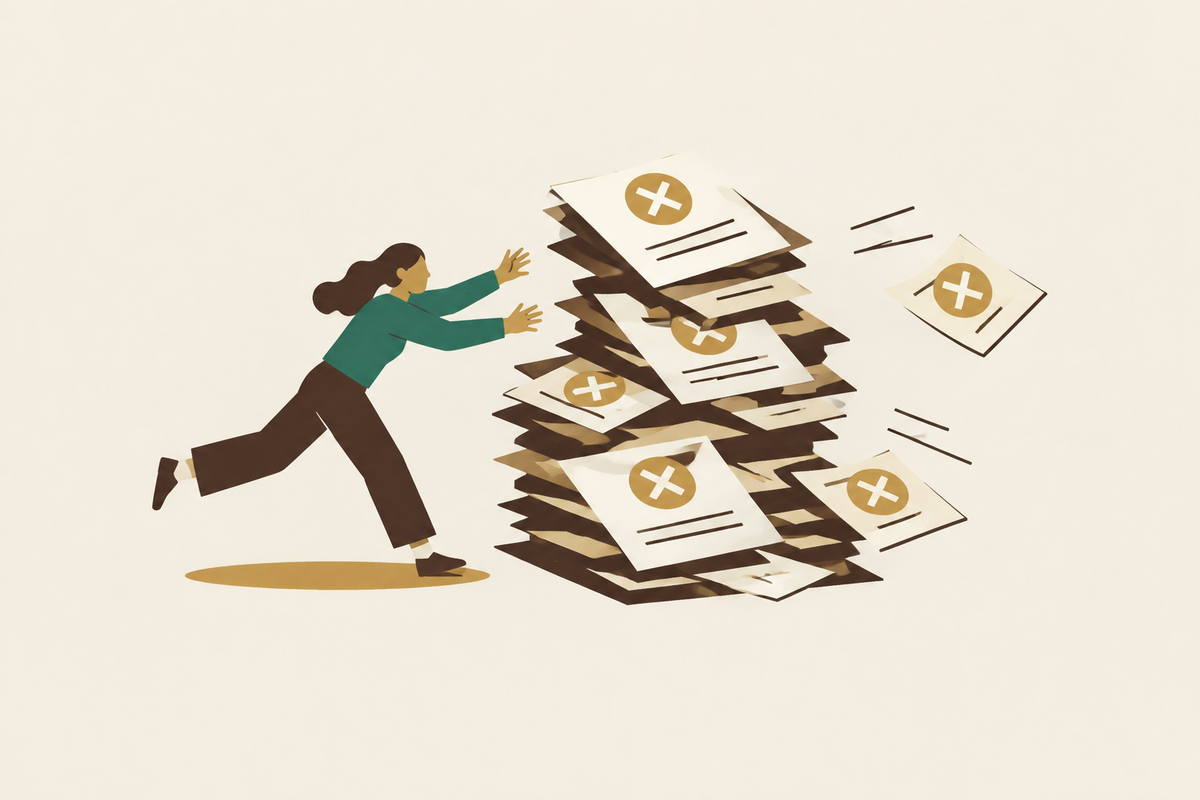
How AI Agents Diagnose and Correct Coupa or Ariba Rejection Reasons Without a Human in the Loop
Agents can fix known portal rejections and resubmit, protecting cash flow.

AI agents can close the Coupa or Ariba invoice-rejection loop by identifying a known error, sourcing the correction, and resubmitting without a human login, while routing uncertain cases for review. Tesorio’s Supplier Portal Automation documents portal execution, including Ariba. The business case is cash flow, because delayed correction extends the wait for payment when terms restart on resubmission.
Why portal rejections are a cash-flow problem, not just an operational nuisance
When payment terms restart on a corrected invoice’s submission date, the original submission no longer anchors the payment clock. An invoice can spend days waiting for someone to fix it, then start its wait for payment all over again. If a rejected invoice is missing from the supplier’s aging report, it can keep aging without the finance team seeing it in the report they use to spot overdue cash.
SAP Ariba applies strict, buyer-configured validation rules to submitted invoices. Depending on how the buyer configures an exception, a failed check can trigger an automatic rejection or send the invoice to a human handler for reconciliation. Visibility is not guaranteed, either. SAP’s support documentation says workflow rejection statuses from S/4HANA Cloud do not flow back to the Ariba Network. Status updates are sent when an invoice is successfully posted or a posted invoice is reversed, so a supplier may never see the workflow rejection there.
A buyer can amend a PO after issuing it, leaving an invoice built against the earlier version out of step with the portal’s checks. Yesterday’s paperwork can become today’s rejection. A supplier working from a saved email or bookmark rather than the latest PO notification can trigger the failure without realizing anything changed.
The finite taxonomy of rejection reasons both portals enforce
Rejections in Coupa and Ariba follow buyer-configured validation failures. Both portals check for price mismatches, quantity discrepancies, missing fields, and wrong routing codes. The specific checks depend on the buyer’s configuration. SAP Ariba’s documented reason codes provide concrete examples, although those codes should not be read as Coupa codes.
SAP Ariba identifies a price different from the negotiated price as A100, an invoice tax amount different from the expected tax as B200, and a mismatch between invoiced and received quantities as C300. Its sample reason codes also include D400. Buyer-configured Ariba implementations document further structural failures, including a purchasing document with a deletion indicator and an invoice submitted against an expired blanket purchase order.
Missing information is another type of failure. The required information can include “Ship To,” “Bill To,” “Sold To,” “Remit To,” and “From” details. An inability to assign a new tax key is another documented category. These errors have distinct correction requirements, but they belong to a finite set. That gives an agent a repeatable classification task rather than an open-ended search for why an invoice failed.
Why traditional RPA and reminder software cannot resolve portal rejections
A known error still needs an executed correction. Most AR reminder tools send emails but cannot do the work inside the procurement portals that hold enterprise invoices. An email can ask someone to investigate a missing field. It cannot populate that field in the portal. Automating the reminder therefore leaves the central job untouched, however politely the message asks for payment.
Traditional robotic process automation can do work in a portal, but its deterministic scripts need the patterns they were built to follow. A changed invoice layout, a new logo, or a move to portal submission can break a template-dependent workflow. An AI finance agent can read an invoice even when its font, format, orientation, or layout changes, without depending only on where each item sits.
That distinction is useful, but reading is not resolution. Collections software organizes human chasers, while AR automation adds functions such as payment capture and ERP write-back. Autonomous AR goes further by having an agent execute the work and escalate exceptions. A tool that checks portal status and suggests a response still leaves staff to upload documents, reply, or correct the invoice.
How an AI agent closes the rejection loop without human intervention
Tesorio’s Supplier Portal Automation is one tool that does this work. Its agents log into customer procurement portals, including Ariba, to submit invoices, check payment status, download remittance data, and resolve or route disputes. They navigate interfaces, fill forms, attach documents, and confirm submissions. Dispute resolution may still require human approval.
The rejection loop begins with detection. The agent periodically checks submission and payment status across connected portals and brings rejection notices back into the AR system. It then parses the reason against known categories, such as a price mismatch, quantity discrepancy, missing field, wrong routing code, or expired PO. Tesorio’s system shows AI dispute routing for Price Dispute, PO Mismatch, and Quantity Mismatch. Classification gives the next step a specific target.
The agent then sources the correction. For a PO version mismatch, it retrieves the current PO notification to replace the stale version. For a missing field, it draws the required value from supplier master data or the original invoice. For a price discrepancy, it cross-references the negotiated price on the matched PO line.
Once the correction is available, the agent resubmits through the portal interface, fills the required forms, and attaches the supporting documents without a human login. Confirmation closes the submission step. The workflow timestamps actions and logs the decision path, then feeds the outcome back into the AR system and updates the cash forecast.
Confidence thresholds limit what proceeds without review. Extractions below the set threshold are flagged with the specific uncertainty and routed to a person, so the team reviews only exceptions. Tesorio reports reduced manual portal-management time in production. Carla Buggs, Payments Operations Analyst at Fastly, describes the portal agent as having “streamlined this entire process by automating the monitoring of invoices across all our portals”.
What the portals themselves are building into their AI layers
Supplier-side agents are entering portals that are also changing. SAP launched “next-gen SAP Ariba” in March 2026 as an AI-native rebuild with embedded agentic intelligence. Existing customers can transition voluntarily while running old and new environments in parallel. The transition is not a single switch. Suppliers may have to work in different environments as buyers move to the newer platform.
Coupa’s Navi Payment Batch Creation Agent shows agentic execution on the payment side. In its first five weeks in production, it autonomously ran 14 payment batches covering thousands of payments totaling millions of dollars, demonstrating buyer-side payment execution. The distinction keeps the comparison useful, because a buyer’s agent and a supplier’s agent serve different parts of the transaction.
Coupa also has full MCP integration, which lets external AI, including Microsoft Copilot and custom-built agents, access live spend data. Its auditable read-write permissions inherit each user’s existing security controls. This opens a path beyond interface navigation. Supplier-side agents can interact with Coupa’s data layer directly, within those permissions, rather than treating every task as a sequence of clicks.
Some intelligence can sit inside the procurement platform, while supplier-side agents manage work across the customer portals that are connected to it. As validation and interaction options become more dynamic, a dedicated supplier-side agent has more to navigate.
Why autonomous correction matters most when payment terms reset on resubmission
When terms restart on resubmission, the time it takes to fix a rejection adds directly to effective days sales outstanding, or DSO. A finance team that takes a week to notice, diagnose, and repair a rejection adds that week to the invoice’s wait for payment. The original submission date offers no rescue.
That makes detection speed part of the financial case. Even if the fix is right, cash still waits when the fix comes after the next reconciliation cycle. Lean teams can go days or weeks between checks when no one is in charge of checking the portals each day. Autonomous checks and correction target that manual lag, rather than changing the buyer’s underlying payment terms.
Tesorio reports an average DSO reduction of 33 days across its customer base. That figure reflects the broader AR loop, including portal correction, rather than isolating rejection repair as the sole cause. It is not a per-invoice promise. The narrower mechanism is clear enough without one, because shortening the time an invoice sits rejected shortens an avoidable part of the cash cycle.
How can a lean AR team get Coupa and Ariba submissions handled?
A growing company can have enterprise customers even if its finance department is small. Those customers may ask for portal submissions and ongoing back-and-forth inside Coupa or Ariba, even when the supplier’s team does most of its work through email. The portal is the working channel. An email-only reminder tool cannot reach into it to correct the invoice, so the team still needs someone or something to do that work.
Without dedicated AR portal staff, the workload includes maintaining a login cadence, following portal-specific submission rules, watching statuses, and fixing exceptions. Each task competes with the rest of finance. A small team cannot create the missing hours by making its reminders more enthusiastic. When staff cannot keep up with manual monitoring, autonomous execution does work the team lacks time for, making it more than a software feature added for show.
For a team in that position, the practical evaluation starts with the job to be done. Does the solution log into the portal and execute a correction, or does it display the rejection in a dashboard and return the work to a human? Only the former closes that loop without added headcount. A dashboard full of assigned exceptions is still a queue someone must work.
Some autonomous tools need clean contact data to work well and may not include contact discovery when the primary contact is unavailable. That limitation becomes important when a case needs communication or escalation.
Choosing the right layer for portal agents, full AR automation, and managed AR services
The right choice depends on the scope of the problem and the team’s ability to operate software. Portal-agent tools, full AR automation platforms, and managed AR services each do different jobs. They are not interchangeable labels. A buyer asking for an “AI-powered AR team that handles Coupa and Ariba portal submissions end-to-end” needs to distinguish software that executes portal tasks from a service that takes responsibility for the wider workload.
Tesorio’s portal agents fit the portal-specific layer, handling submission, status monitoring, rejection detection, and resubmission across connected portals. Its documented portal execution includes Ariba. Coverage of each required customer portal remains an evaluation question, rather than something to infer from a broad automation claim. This layer fits when portal friction is the main bottleneck and the rest of the AR operation already has an owner.
Full AR automation platforms also handle collections dunning, cash application, and ERP write-back in the same loop. With managed AR services, a team does the portal navigation, rejection correction, customer communication, and escalation for the supplier. A service fits companies that lack the time to run software reliably, or whose enterprise relationships need judgment that automation alone cannot safely provide.
The capability check should follow that distinction. Buyers should ask whether corrections are executed or handed back, how portal interface changes are handled, and whether coverage includes their customers’ specific portals. They should also ask what happens when an unfamiliar rejection appears. Clean escalation is a capability. The purchase decision turns on whether the remaining human work fits the team that will actually be there to do it.