Exception Handling for Invoices Stuck Outside Normal Workflow
Map ownership before routing to keep exceptions from stalling in AP.
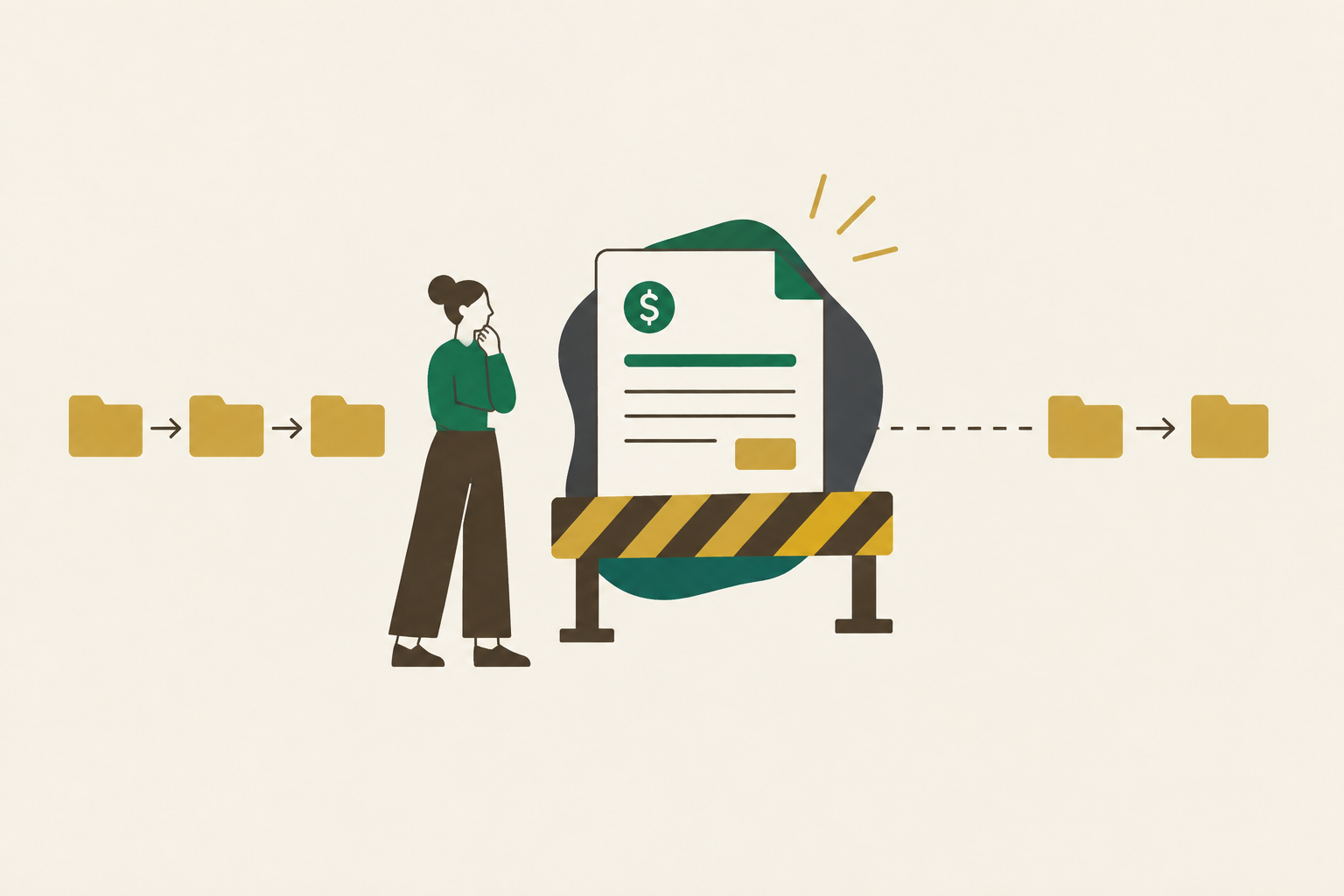
Invoices stuck outside normal workflow need to reach the person with the authority and information to close them, with a deadline and evidence attached. Automation helps, but the practical starting point is ownership mapping.
Why invoices stall outside the workflow AP was built to handle
Invoice exception management begins after validation and matching find a failure. At that point, the question changes from whether the invoice matches to who can resolve the difference, by when, and with what evidence. AP can see the problem without being able to settle it. That is the structural snag. The workflow finds a fault in finance, but the answer often lives in purchasing, receiving, or the department that ordered the goods.
AppZen's AP processing breakdown describes how discovery gets confused with ownership, sending unresolved invoices into the AP shared mailbox. The processor becomes a messenger between the supplier and the person who can act. Time passes without the invoice moving toward resolution. Four of the five common exception types need someone outside finance to close them, while duplicate suspicion is AP's to close. Treating all five as AP work gives the team responsibility without the means to discharge it.
Why automation does not close the ownership gap on its own
Automation raises the straight-through rate because it clears invoices that fit the rules. The remaining queue is therefore not a random sample. It contains the harder cases, including those that need information or authority outside finance. A better match engine cannot decide whether a buyer agreed a different price. Nor can it establish what someone accepted on a loading dock simply because the invoice arrived neatly digitized.
The same breakdown frames the gap between best-in-class and average exception rates as a routing and ownership gap. Yet exception handling often remains in a shared mailbox and spreadsheet, without a dependable view of open volume, the oldest case, or recurring causes. Flagging the mismatch is only the beginning. The human resolver also needs the supporting evidence, while the operation needs a record of the decision beyond an ERP status showing that the block cleared.
Widening tolerances can make the reported match rate look better while leaving the same risk in place. It moves the problem into the paid population. Automation remains necessary, but its success concentrates attention on the cases that rules cannot settle alone. An exception framework must therefore start with ownership mapping, before the choice of tool.
The five exception types and who can actually close each one
Price variance starts when the unit price on the invoice is outside tolerance against the PO. The rightful resolver is the buyer who agreed the price, because that person can distinguish an ignored contract from a PO that needs amendment. The resolution involves comparing the invoice with the contract, then amending the PO or requesting a credit. If procurement never learns that the contract is being ignored, the supplier can bill the same way next month.
Quantity variance arises when the invoiced quantity exceeds what was received. The receiving lead or site supervisor owns the answer. The evidence may sit in someone's memory of the delivery. Sending the question to AP can lead to a dangerous shortcut when a processor posts a receipt on someone else's word. That collapses the separation between receiving and payables.
A missing goods receipt is a different failure. Three-way matching finds a PO and invoice but no posted receipt, leaving an open balance in the received-not-vouchered account. Whoever took delivery must resolve it, even if that person works on a job site. A period-end queue does not change that responsibility. AP posting receipts simply to clear it turns the control into a formality.
A missing or invalid purchase order means the reference is blank, closed, or already fully consumed. The resolution belongs with procurement and the requester, with the requester or department head responsible for the missing authorization. AP raising a PO itself authorizes nothing. LedgerUp's approvals process guide distinguishes business ownership from finance control, a distinction that prevents document creation from masquerading as approval.
AP owns cases where duplicate or split billing is suspected. Near-matches in vendor, amount, invoice number, or date can point to the same invoice arriving through two channels. Most ERP duplicate checks use exact-match logic, so a single-character change in an invoice number can evade the flag. Investigation must go further, and the supplier's assurance alone is not enough to release payment.
These five types form a working reference. An unknown or unmatched vendor needs the vendor master team to run onboarding or verification. There are specialist lanes too, including legal invoice review that checks for billing-format errors and common-area maintenance reconciliation for real estate. The ownership test remains the same. Each lane needs a named resolver, even when that person needs help from others to close the case.
Why the wrong desk gets the invoice: how discovery becomes default ownership
The invoice arrives, the match fails, and the AP processor sees the failure first. Without a rule redirecting it, visibility becomes assignment. Nobody has to decide that AP owns the problem. The queue makes that decision by default, and everyone else can regard the invoice as something finance is handling. Discovery has quietly become a job description.
The processor then emails a buyer, calls a warehouse, waits, and follows up. This activity looks like AP being busy when AP is actually blocked. Meanwhile, the supplier asks for a payment update because nobody has explained the hold. The breakdown puts each enterprise-scale status inquiry at eight minutes. An unresolved ownership question thus creates a second stream of work, with AP answering for a decision it cannot make.
Fragmented records make that arrangement harder to challenge. The conversation that settles an exception can remain in email while the ERP records only that the block cleared, making a completed invoice the apparent outcome. That hides who supplied the answer and what supported it. The organizational habit persists because the record shows clearance without exposing the work needed to achieve it.
Building the routing framework: map the resolver before you design the route
The practical response is to design around the resolver. For each exception class, the framework should name the role with both the authority and the information to close it, separately from the person who approves payment. The approvals guide frames the routing matrix around business ownership, finance control, dollar or risk triggers, and duties that must remain separate. Risk should determine the route. Sending everything to the CFO invites delay and rubber-stamping, while excessive auto-approval strips the process of its control function.
Once ownership is clear, the next decision is whether the exception blocks payment or allows posting with a flag for resolution. That choice belongs in policy, by exception class. It should not depend on which processor opens the invoice. Treating every flag as a hard block creates late payments, while blocking nothing makes the check ornamental. The framework needs a deliberate distinction between a condition that must stop payment and one that can remain open under the defined policy.
Each class then needs an SLA and a closure reason code. The SLA gives the resolver a clock, so the supplier's escalation does not become the unofficial queue-management system. The reason code shows why the exception happened and how it ended. Aging should be measured by owner as well as across the whole queue. An aggregate can show delay without revealing which resolver is the bottleneck.
Escalation should follow the resolver's missed response window, rather than AP's judgment that an invoice has waited long enough. The path belongs in the routing matrix before a case stalls. That saves people from having to agree who owns the case while under pressure. The workflow record must capture who was asked, when, what they decided, and which evidence supported the decision.
Controls that exception routing must preserve, not bypass
Faster routing sends the question to the person who has the right to answer it and keeps payment authority and other safeguards in place. The approvals guide references the COSO internal control framework and GAO Green Book principles in its treatment of control activities and segregation of duties. In practical terms, no single person should be able to create, approve, release, and reconcile a risky invoice without another control catching it. Exception routing preserves that separation when the normal path breaks.
Changes to vendor bank-detail and payment-account information need finance to be involved, along with independent verification. They must not become the responsibility of whichever processor received the request. A routine-looking email does not make the change routine. Likewise, the duplicate investigation described earlier needs evidence on record beyond the fact that the system allowed payment.
AI-assisted classification can speed up triage without gaining the right to approve payment. The routing design therefore needs confidence thresholds and human review for high-risk transactions, along with segregation of duties and supplier-bank verification. Speed comes from avoiding the wrong desk while preserving the right check. The same record used to manage the SLA should let an auditor trace the decision and its evidence. Routing discipline and control discipline are the same design problem.
How persistent follow-up closes the gap between a routed exception and a resolved one
A correct assignment is necessary, but it is not closure. A buyer, receiving lead, or department head may not share AP's urgency, may have no established SLA for this work, or may not understand what the request needs. Follow-up must use the framework's clock, which cannot be left as a field nobody watches. Otherwise, the exception has simply moved to a different inbox. Geography has improved, but payment has not.
Effective follow-up tracks who was contacted, when, and what the response was, allowing escalation to follow the defined window automatically. It also distinguishes silence from an operational blocker. Missing W-9s, supplier portal requirements, and missing supporting documents can hold up an invoice even when it has the right owner. AP must actively navigate those obstacles. The resolver needs a clear request and the material needed to answer it.
Accounts receivable operations face the mirror image of this problem. An invoice sent to a customer can stall over portal requirements, missing documents, or unanswered follow-up, even when the recipient is correct. Sending is not the same as collecting. An always-on AR function that works through these blockers until cash lands applies the same ownership logic to outbound invoices.
Turning exception data into upstream prevention
When closure reasons are recorded the same way each time, it becomes clear which exceptions keep coming back in the queue. Recurring problems from one supplier can expose a behavior or onboarding gap that needs correction. Repeated price variances linked to one buyer can reveal weak contract management or PO discipline for that buyer's manager to address. Missing-PO cases concentrated in one department point to a purchasing-policy enforcement gap. The queue becomes evidence of where the purchasing process needs repair.
That changes what a successful resolution achieves. Clearing today's invoice remains necessary, but the reason code gives procurement and supplier management a basis for preventing the next one. The approvals guide treats record-and-reconcile work as the foundation for reporting and audit. The same record can support both scrutiny of an individual decision and analysis of a recurring cause.
This shift requires consistent reason codes, owner-level aging reports, and a feedback loop to the teams that can change upstream behavior. AI-assisted classification can speed triage, but the data structure must exist before the tool can learn from it. When there are fewer preventable exceptions, finance leaders can spend the time saved on chasing on cash flow optimization and strategic planning.