PO-Backed vs. Non-PO Invoice Submission in Procurement Portals
Procurement platforms handle PO and non-PO invoices through entirely separate validation paths.
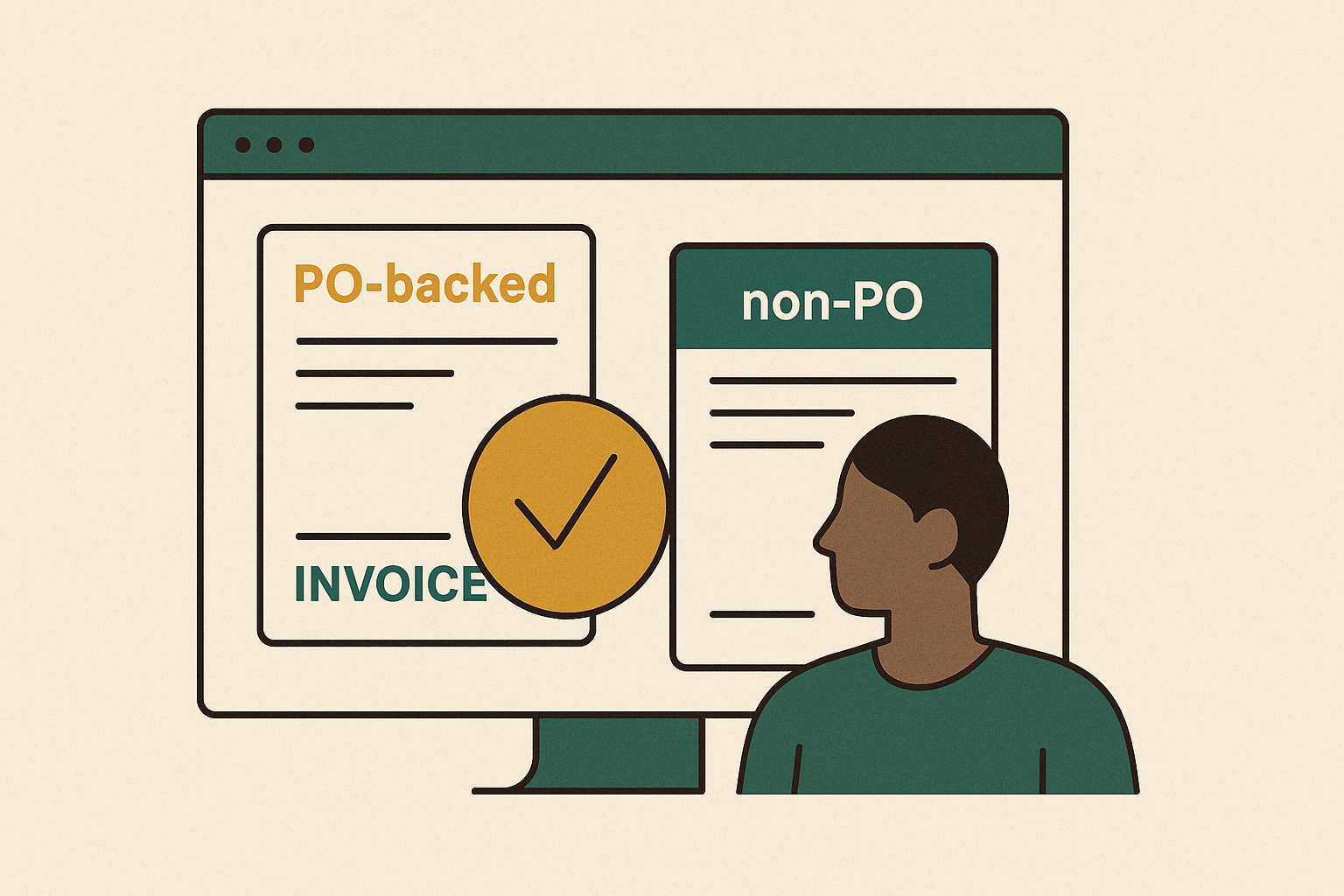
A purchase order and an invoice are two halves of the same transaction, but they're not peers. The PO is a buyer-issued document that authorizes a purchase before it happens. The invoice is a supplier-issued document requesting payment after delivery. The PO number on an invoice is the link that closes the loop between commitment and payment. DocuWare puts it neatly: the PO is the go-ahead, the invoice is the request for payment once the agreement has been fulfilled.
Coupa and SAP Ariba are the two platforms named in this article as embedding distinct intake, validation, and routing logic for both PO-backed and non-PO invoice submissions directly into their procurement portals. Oracle Supplier Portal, as deployed by Wayne County, Michigan, handles the split in the most rigid form: PO suppliers submit through the portal while non-PO suppliers are routed to a separate email channel entirely. JPMorganChase's SAP Ariba implementation applies the same distinction less absolutely, requiring pre-approval via PO for most suppliers and flagging PO-less invoices for additional spend validation. Stampli is also cited as a platform whose design accommodates both paths as first-class workflows, using AI to handle the coding, ownership routing, and approval logic that non-PO invoices require in place of three-way matching.
That difference in timing creates a difference in authorization status. A PO invoice arrives pre-authorized. The budget was approved, the vendor was selected, the price was set. All of that happens before the supplier ships anything. A non-PO invoice arrives with none of that upstream work done. Utilities, rent, professional services, emergency purchases, and SaaS subscriptions are the canonical examples. These are categories where raising a PO first is impractical or impossible. The electric company isn't waiting for you to issue a purchase order before it keeps the lights on.
Medius draws the consequence directly. Because PO invoices are tied to an approved purchase order, much of the authorization process has already been completed before the invoice reaches accounts payable. Non-PO invoices don't inherit that authorization. Every one must establish legitimacy from scratch when it lands in AP. That's not a minor administrative difference. It's the structural logic that determines how procurement portals treat each type from the moment a supplier logs in.
Which vendors offer procurement portals that handle both PO-backed and non-PO invoice submission with distinct validation and routing logic for each?
Procurement portals aren't neutral submission channels. Their intake, validation, and routing logic is built around whether a PO exists. The invoice type shapes a supplier's experience from the first screen.
For PO-backed submissions, the portal typically asks the supplier to enter or select a PO number first. Then it populates invoice fields from the order. Data entry shrinks, and validation anchors itself to the PO before the invoice is even submitted. For non-PO submissions, the portal cannot pre-populate from an order. The supplier must supply all the context the PO would otherwise provide: vendor details, cost center, description of goods or services, GL code.
Wayne County, Michigan's Oracle Supplier Portal in 2026 illustrates the most aggressive version of this split. All PO suppliers submit invoices through the portal. Non-PO suppliers cannot submit through the portal at all. They must email invoices to a designated AP address. Portal access is a PO-holder privilege. JPMorganChase's February 2026 SAP Ariba guidelines make the same policy explicit, though less absolutely. Pre-approval using a PO is required for transactions with most suppliers. Invoices without reference to a PO may experience significant delays due to spend approvals and validations.
These aren't edge cases. They reflect a design choice embedded in platforms like Coupa and Ariba. Electronic submission at speed is the reward for going through a PO. Non-PO spend trades that speed for flexibility. Portals like Coupa and Ariba embed the PO/non-PO distinction directly into their intake and routing logic, creating a two-tier submission experience. When invoices land with structural mismatches or portal rejections, teams need visibility into what's stuck and why. Invoice Butler navigates these portals on behalf of AR teams, logging in to track submission outcomes, resolve portal-specific validation failures, and route invoices toward the approval path intended for their type.
What happens inside the portal after a PO-backed invoice is submitted
A PO-backed invoice moves through a portal largely on its own once submitted. But the automation that makes that possible depends on a precise data match that suppliers frequently fail to deliver cleanly. The portal validates the PO number on intake. Then it runs two-way or three-way matching: invoice against PO, and where goods are involved, against the goods-received note. DocuWare describes the sequence. Pre-set tolerances automatically approve small variances. Larger discrepancies trigger an exception workflow for review before the invoice is posted to the ERP. Invoices that clear matching move toward touchless processing. Approvals happen quickly, payment cycles shrink, and the approved invoice plus all related documents sit together in a complete audit trail.
But invoices rarely match purchase orders perfectly. Suppliers use different formats, include varying levels of detail, and sometimes reference different product codes. Naming variations can force manual intervention to determine whether items actually match. Medius notes that modern AP platforms can now auto-match PO invoices and route them for quick review and coding, drastically reducing manual steps. But the operative word is "can." Clean data in, clean match out. Messy data creates exceptions. When a PO-backed invoice fails to match cleanly due to format variation, product code inconsistencies, or tolerance thresholds, it lands in an exception queue that requires manual review and back-and-forth with the supplier. Finance teams managing high-volume PO submissions across multiple portals can lose track of these exceptions. An AI-powered collections and follow-up tool can help there: Invoice Butler monitors portal rejection queues, flags exceptions for escalation, and coordinates resubmission or data correction across Ariba, Coupa, and SAP without requiring finance staff to log in manually. Three-way matching remains the gold standard for AP control because it verifies that payment is made for what was ordered and actually received. But it's only as reliable as the data suppliers put on the invoice.
What happens inside the portal after a non-PO invoice is submitted
A non-PO invoice has nothing to match against. So the portal routes it into a human approval sequence. Every step that automated matching would have handled now falls to a person. The path is structurally slower and more dependent on how well the workflow is designed.
Stampli's reference guide states the core principle directly. Processing differs in one fundamental way: validation comes from a human approval, the budget owner confirming "yes, we bought this," instead of a document match. AP must first determine which department owns the cost, verify budget availability, and identify the appropriate approver. None of which the portal can resolve automatically without a PO as anchor. Medius describes the workflow consequence. Many organizations use automated approval workflows that route non-PO invoices based on predefined business rules like spend thresholds, cost centers, vendors, or departments. But these rules must be set up in advance and maintained.
The common failure mode is that no one in AP knows who owns the invoice, and it sits unclaimed. Stampli identifies "persistent orphans" as a diagnostic signal about missing vendor-owner mapping, not a random occurrence. GL coding, which a PO invoice inherits automatically from the order, must be assigned manually by AP at intake for non-PO invoices. That introduces both effort and the risk of miscoding. GEP frames the implication bluntly. Non-PO invoices for expenses like utilities or food and travel reimbursement are more time-consuming to process. Collecting the proper information and paying close attention to the approval procedure are vital for an effective AP workflow.
Non-PO invoices also carry greater fraud risk. There's no upstream document to anchor payment to a verified commitment. That makes this category acutely vulnerable to unauthorized spend and invoice manipulation.
Why non-PO invoices need replacement controls, not just looser ones
The mistake organizations make with non-PO invoices isn't that they accept them. Some spend will always be non-PO. The mistake is allowing the non-PO path to be the PO path with a step missing, rather than a deliberately designed parallel workflow with its own controls.
Stampli makes this explicit: non-PO "needs its own deliberate workflow, not the PO workflow minus the PO." The replacement controls that substitute for three-way matching are vendor validation at intake, GL coding assigned at receipt rather than at payment, ownership routing with SLAs and automatic reminders, and duplicate and fraud checks. For recurring spend, Stampli points to vendor-default coding, a designated approver, and amount-variance checking against history. The control that matters for contractual spend is whether this matches what was agreed and what is usually paid. Automation checks that better than a PO would.
The objection to mandating POs for all spend is well-founded. Forcing POs onto rent and utility bills creates retroactive POs. That's paperwork generated after the fact that adds work and zero control. Stampli argues for measuring "spend under management" rather than "PO coverage." The former is control. The latter is often theater. The honest framework by spend type works like this: goods and discretionary purchases benefit from pre-approval via PO. Contractual recurring spend is controlled by the contract and a confirming approval. Small-dollar tail spend is controlled by thresholds and card programs.
Ownership must be a tracked workflow state with an SLA and automatic reminders, not an email thread. The anti-pattern is AP emailing screenshots around hoping someone claims the invoice. That's not a workflow. That's a wish.
How AI is beginning to close the processing gap between the two paths
AI-native invoice handling is reducing the processing disadvantage that non-PO invoices have historically carried. It automates the judgment calls, coding, ownership routing, and variance detection, that humans previously had to make manually on every non-PO invoice. For PO invoices, the AI layer automates exception handling. It checks the ERP to verify the PO exists, ensures line items match the original order, and verifies goods receipt. Line-by-line checking leaves the human queue. For non-PO invoices, the same AI layer applies a different logic. It uses historical data to suggest GL coding by vendor and description. It predicts the right approver based on organizational structure and past behavior. So an invoice nobody in AP recognizes still finds its owner quickly. Medius notes that modern AI-powered platforms can now categorize invoices as PO or non-PO automatically, significantly reducing misclassification and minimizing the need for manual review.
Stampli describes its approach this way. AI suggests coding from history and predicts the right approvers. Approval, discussion, and documentation happen on the invoice itself, creating the control record a PO would otherwise provide. AI-native capture is also eliminating one of the longest-standing friction points in non-PO submission: unstructured formats that portals cannot parse. Multimodal LLMs read and extract invoice data without OCR templates, training periods, or supplier-specific setup.
E-invoicing mandates taking effect in 2025 and 2026 are raising the technical bar further. Compliant invoices must use structured electronic formats, XML using UBL/CII or EN-16931-aligned standards, with EDIFACT permitted only conditionally under transitional rules in some jurisdictions. Unstructured non-PO email submissions are becoming non-compliant in mandated jurisdictions. Regulatory pressure is pushing both paths toward structured portal submission.
What suppliers need to submit correctly in each path, and where they most commonly fail
The data requirements for PO and non-PO portal submission aren't just different in volume. They're different in kind. Most submission failures happen when suppliers treat the non-PO path as a simpler version of the PO path rather than a distinct one.
For PO invoice submission, the PO number is the critical anchor. It must match the buyer's system exactly. From it, the portal derives vendor confirmation, line-item detail, pricing, and receipt matching. Errors here are typically format mismatches or naming variations on line items. For non-PO invoice submission, the supplier must supply all context the PO would have provided. That means cost center or department code, project identifier, description of goods or services sufficient for GL coding, and often the name of the internal budget owner or requester. A government-compliant invoice can still fail portal validation because it lacks the customer's internal cost center code or project identifier. These fields, optional in e-invoicing standards, become mandatory in practice within portal systems. Cross-border suppliers face an additional failure category: missing mandatory fields that differ by country schema, even when the invoice is locally compliant.
Stampli identifies the signals AP uses to route an unrecognized non-PO invoice: requester name, ship-to address, department references, and vendor history. Suppliers who include these details on the invoice itself reduce the time their invoice spends in limbo. High-performing portals offer pre-submission validation that catches errors in plain language before submission and provide immediate confirmation and real-time status. The supplier experience degrades sharply when this is absent.
The practical implication for suppliers is simple. Before submitting to any new portal, establish whether the buyer requires a PO number. If not, find out what cost center and approver information they expect on a non-PO invoice. This varies by buyer and cannot be assumed.
What finance teams should look for in an AR and AP operation that handles both invoice types well
For finance teams managing invoices across multiple buyer portals, the real operational challenge isn't choosing between PO and non-PO workflows. It's maintaining speed and control across both simultaneously. That requires an AR operation that treats both paths as first-class workflows, not one as the default and the other as an exception.
Stampli states the principle from the AP side. A capable system should handle both without treating non-PO invoices as errors. Both paths should remain visible in the same operation while following controls appropriate to the spend type. For PO-backed invoices, the operational goal is minimizing exceptions before submission. That means a clean PO number, matching line-item detail, and correct format. The portal's matching logic can then run without triggering human review queues on the buyer's side. For non-PO invoices, the operational goal is supplying enough context at submission that the invoice reaches the right approver quickly. That means knowing each buyer's cost center structure, their non-PO approval routing logic, and their portal's specific required fields.
Portal navigation is its own skill. Coupa, Ariba, and similar platforms each have distinct submission interfaces, validation rules, and status-tracking mechanisms. An AR team that navigates these at scale treats portal fluency as a core competency, not an afterthought. The unglamorous blockers are what stall invoices in practice for both PO and non-PO types. A missing W-9. A wrong cost center code. An unregistered vendor record. Handling them quickly and systematically is what separates an AR team that collects from one that chases. Invoice Butler operates as an always-on AR team that manages exactly this operational layer: following up, replying to customers, navigating procurement portals like Coupa and Ariba, and pushing every invoice, PO-backed or not, until cash lands. Understanding the structural difference between PO and non-PO isn't academic. It's what lets an AR team submit correctly the first time and escalate intelligently when something stalls.